
Rehearsal for the Hard Day
Part of the AURIS approach to identity, stability and human development.
- Applied
- £29.00
- Certificate on completion
- About 75 minutes
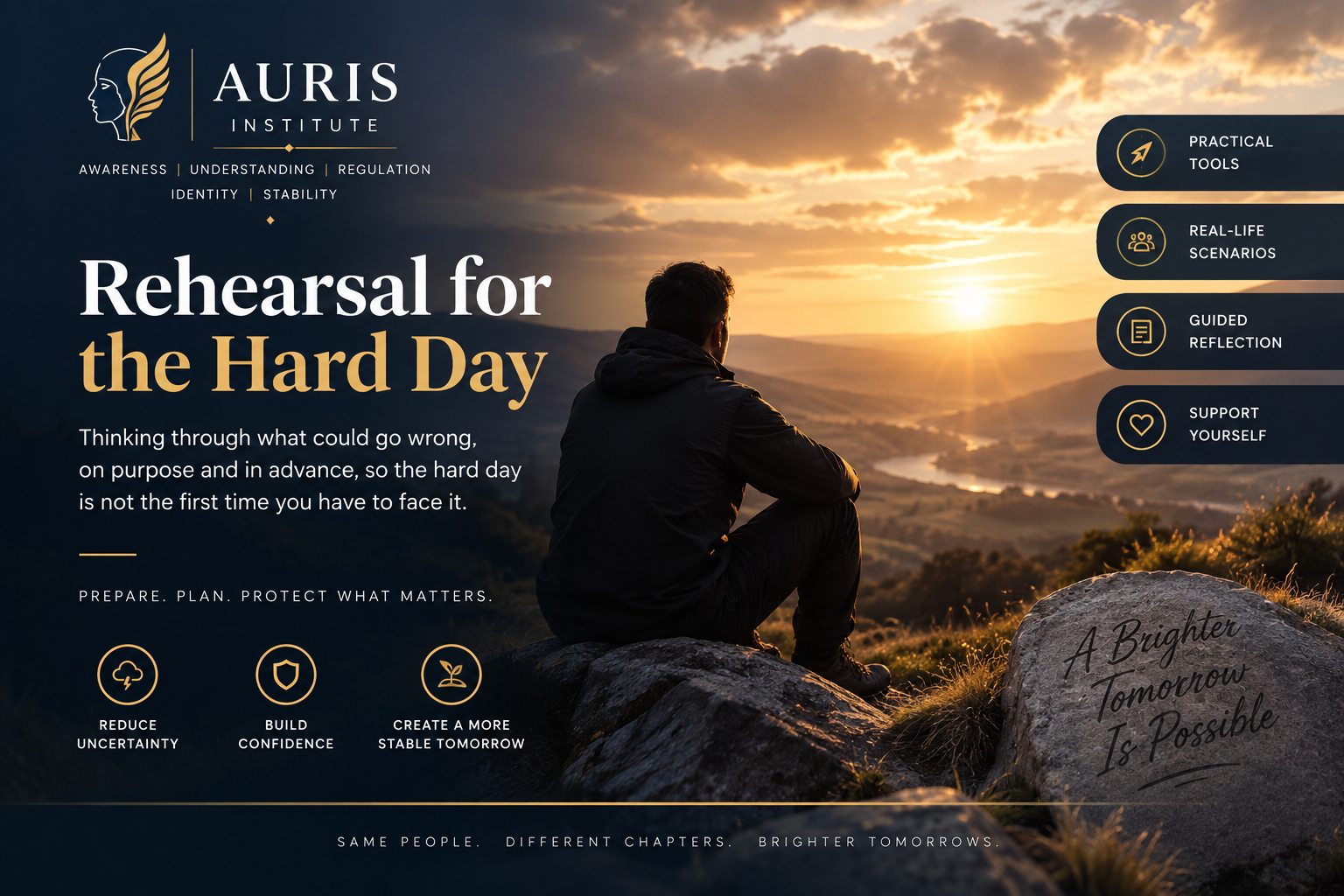
Thinking through what could go wrong, on purpose and in advance, so the hard day is not the first time you have considered it.
What you'll leave with
You can prepare for difficulty without living in it. What You Stand For turns to the part of you that does the meeting.
Watch the course introduction
Watch this before you begin
Hard days cost more when they arrive as a complete surprise. Watch this conversation and notice how experience changes once warning signs, pressure and likely responses are named. Then use the course to rehearse your own response before you need it.
£29.00 one-off payment, lifetime access
- 1. Sign in, or create a free account. It takes a name, an email address and a password.
- 2. Pay by card on the course page. The payment form is Stripe's own, so AURIS never sees or stores your card details.
- 3. The course opens straight away and stays in your library. There is no subscription and nothing renews.
A certificate is issued when you finish every lesson and pass the assessment.
Course illustration
Who this course is for
“One difficult day knocks me sideways every time.”
Surprise is expensive. Thinking a likely difficulty through once, on a calm day, costs far less than meeting it cold.
Suggested learning pathways
Where this course fits
- Where it sits
- Specialist learning inside the Discipline and Self Command pathway.
- What usually comes before
- Most people take Staying Switched On before this one, though nothing here requires it.
- What usually comes next
- What You Stand For is next in the Discipline and Self Command pathway. Names the part of you that does the meeting, without a job title.
A pathway is a suggested order, not a requirement. Nothing here has to be bought to make this course work.
The pathways it belongs to
- Part of the Discipline and Self Command pathway: How do you stay steady when you cannot change what is happening?
A pathway is a suggested order, not a requirement. This course can be taken on its own.
About this course and why it matters
About this course
A paid course on rehearsing difficulty in advance, deliberately and briefly, so the day it arrives you are meeting something you have already thought through.
Why this matters
Primary pillar: Regulation. Secondary pillar: Understanding. This course builds Regulation by thinking a difficulty through once, deliberately and in advance, so the day it arrives is not the first time you have met it.
What you will learn
- Rehearse a likely difficulty briefly and deliberately
- Separate rehearsal from rumination
- Prepare a first response rather than a full plan
- Use rehearsal without letting it become worry
Course curriculum · 4 lessons
Course curriculum
4 lessons. The lesson content itself opens once you start the course.
Lesson 1 · about 20 minutes
Why surprise costs so much
A cancelled appointment can be met by checking the new arrangement and informing anyone affected.
- Choose a suitable low-intensity scenario and identify a first action, support and stop rule.
- Explain the reasons for a response and recognise what cannot be inferred from this exercise.
Lesson 2 · about 20 minutes
Rehearsal is not worry
Repeatedly imagining the same event without a useful decision is a reason to stop.
- Recognise repetitive worry, stop, and select an ordinary planning alternative without penalty.
- Explain the reasons for a response and recognise what cannot be inferred from this exercise.
Lesson 3 · about 20 minutes
The first hour
If the original contact is unavailable, use the agreed alternative.
- Adapt the first response when new information changes the situation, including urgent support when needed.
- Explain the reasons for a response and recognise what cannot be inferred from this exercise.
Lesson 4 · about 15 minutes
How often, and when to stop
“I now know whom to contact, but the imagery is uncomfortable” supports keeping the practical contact note and stopping imagery.
- Explain whether to keep, change or stop a planning exercise and what evidence informs that choice.
- Explain the reasons for a response and recognise what cannot be inferred from this exercise.
What is included
- Audio narration
- Guided reflections
- Interactive exercises
- Practical activities
- Downloadable worksheets
- Assessment
- Certificate on completion
Before you start
None. This course can be taken on its own. Controlling the Controllables is optional preparation.
After you finish
After you finish
You can prepare for difficulty without living in it. What You Stand For turns to the part of you that does the meeting.
Common questions
How much does Rehearsal for the Hard Day cost?
It is £29, paid once. You keep lifetime access to the course, including future research driven updates. There is no subscription or renewal.
Do I get a certificate?
Yes. Complete every lesson and pass the required assessment to receive an AURIS Certificate of Completion in your name. It records your learning. The separate Practitioner Certification is an internal AURIS programme; neither certificate is an externally accredited qualification or a clinical licence to practise.
How long does it take, and is it self-paced?
Study at your own pace. Lessons open in sequence after you complete the previous lesson; there is no daily waiting period for this course, and the course is designed to take about 75 minutes in total.
What work do I need to complete?
Lessons include practical activities and saved reflections. Some courses also require portfolio entries and an assessment; the lesson and assessment pages identify required work. Use ordinary or fictional examples where appropriate and avoid identifying details. Reading or listening alone does not complete a lesson.
Do I need to do anything before this course?
None. This course can be taken on its own. Controlling the Controllables is optional preparation.
Next steps and related courses
Course progression
- Foundation
- Applied
- Practitioner
Practical Skills pathway 3 of 5. Prospective coping and first-response planning; Practical Skills is not an AURIS pillar.
Related courses
Suggested preparation
Staying Switched On
Course detailsSuggested next course
What You Stand For
Course details
Evidence, sources and limitations
Research and evidence
Primary sources: Seneca on anticipatory reflection/premeditatio malorum; Marcus Aurelius on anticipating difficulties. Contemporary AURIS framing treats rehearsal as a brief preparation exercise, not a validated clinical intervention and not evidence that anticipated events cause less distress.
The evidence behind this course
Evidence
Letters to Lucilius, on rehearsing misfortune in advance — Seneca
The primary source for thinking a likely difficulty through once, deliberately and in advance.
Meditations, Book 2, opening passage — Marcus Aurelius
The primary source for preparing for the difficulty of a day at its start rather than being surprised by it.
The development and validation of the stoic attitudes and behaviours scale — LeBon, Brown, DiGiuseppe, Karl, Fischer and Lopez, 2025 (Read source)
Stoic attitudes and behaviours can be measured, which is the basis for teaching these practices as trainable habits rather than as a philosophy to agree with.
How AURIS interprets it
- AURIS reads rehearsal as Regulation work with Understanding alongside it, because a difficulty met once in advance is met with a prepared first response rather than a first reaction.
- AURIS draws a line between rehearsal and rumination and teaches the stopping rule as part of the practice, not as an afterthought.
What you do with it
- You rehearse a likely difficulty briefly and prepare a first response rather than a full plan.
- You recognise when rehearsal has turned into worry, and stop.
Ready to begin?
£29.00 one-off payment, with lifetime access to the course.