
Identity in Global Transition Policy
A six nation audit of what transition policy says, and does not say, about identity
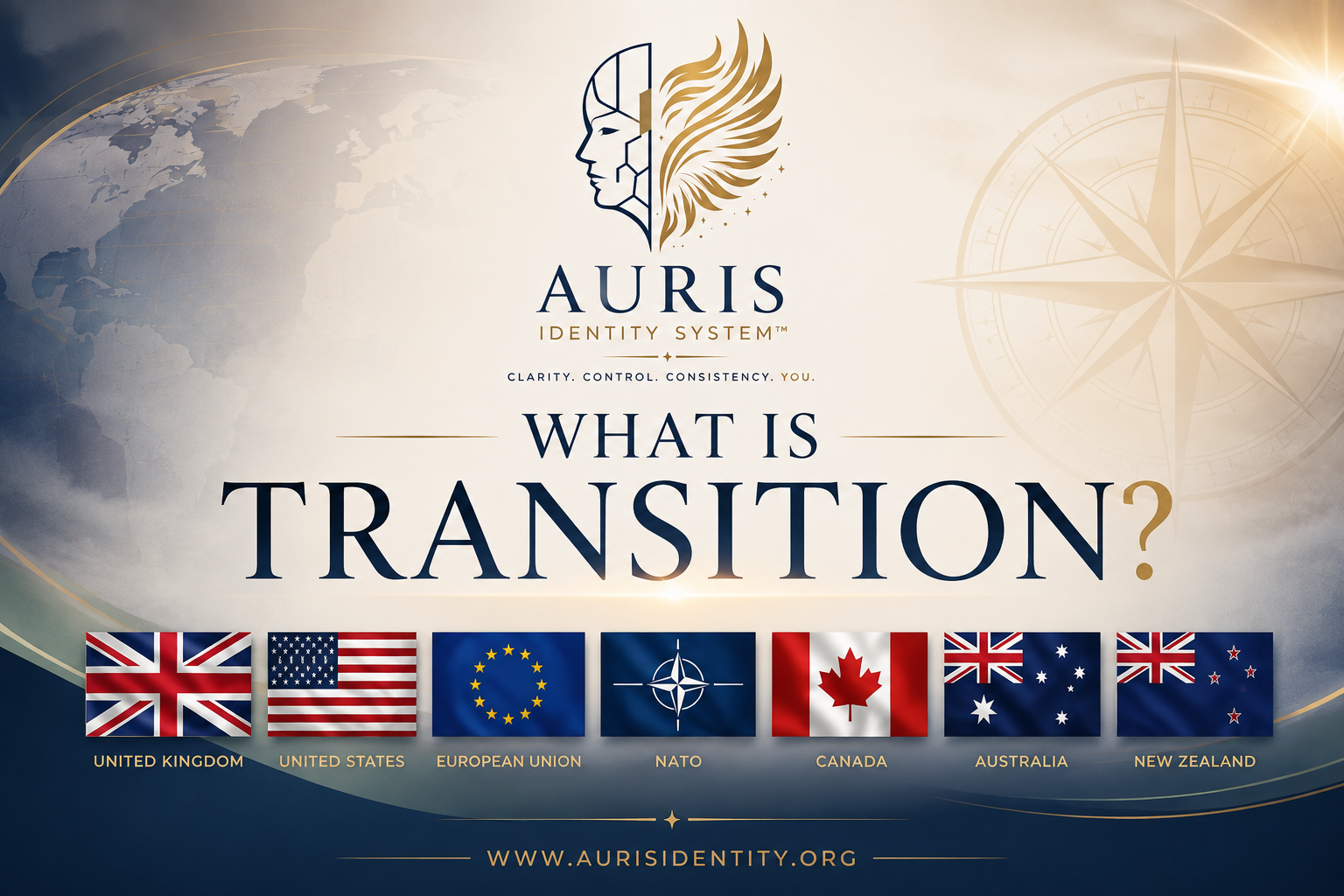
We reviewed transition policy across the UK, US, Australia, Canada, New Zealand and NATO to see where, if anywhere, identity is treated as a structural part of transition rather than an afterthought.
Why this research exists
Identity After the Uniform is a doctoral research programme asking a single question with real rigour. Who am I, once the role that shaped me for years is gone. It is built on the position that identity, not employment, is the central challenge of transition for people leaving uniformed and identity defining roles, including military, police, fire, ambulance and NHS clinical service.
This audit was carried out to test that position against current government, charity and employer transition policy across the UK and five comparator jurisdictions, and to see whether identity is treated as a structural part of transition anywhere else in the world.
What we looked for
We reviewed current transition policy and support programmes across the UK, the United States, Australia, Canada, New Zealand and NATO, covering government policy, charity and non profit frameworks, and employer programmes, and asked one question of each source. Does this treat identity as a named, structural part of transition, or does it treat transition as primarily an employment and administrative process.
Findings by jurisdiction
- United Kingdom
- The Defence Holistic Transition Policy, launched alongside Defence Transition Services in 2019, named identity explicitly, alongside housing, health and family life, as an element of transition requiring dedicated support. The current governing resettlement policy, JSP 534, was reissued as Issue 24 in March 2025.
- United States
- The mandatory Transition Assistance Program remains built around career readiness, financial planning, education and employment. Running alongside it, outside the mandatory track, is the Vector Accelerator programme, delivered through The Honor Foundation, which places identity clarity and introspection as the first step of transition, ahead of career planning. This is the closest conceptual parallel to AURIS found anywhere in this audit.
- Australia
- The Joint Transition Authority is an active government body coordinating the Australian Defence Force transition journey. Identity has not yet been found named directly in its published material, which makes Australia a useful contrast case for the employment focused end of the transition support spectrum.
- Canada
- The Canadian Armed Forces' official My Transition 101 training includes an optional unit built around three named modules, Identity, Emotions, and Body and Mind. This is the clearest example found of a government transition programme naming identity as a discrete, taught component.
- New Zealand
- The New Zealand Defence Force's own official transition guide states plainly that an important part of a service leaver's identity may feel lost. Separately, peer reviewed New Zealand research surveying 1,037 veterans documented identity conflict and identity confusion as recurring themes, and called directly for programmes to address loss of identity.
- NATO
- A NATO Science and Technology Organisation technical report on the transition of military veterans from active service to civilian life states that comparatively little work has gone into conceptualising how transition occurs, or into properly measuring what a successful transition looks like, across NATO and partner nations.
What this tells us
Across six jurisdictions, identity appears in transition policy only in fragments. A sentence in a policy launch here. A training module there. A programme running quietly alongside the main offer, rather than as the main offer. It is acknowledged often enough to show that governments and organisations know it matters, and rarely enough that almost nobody has built a structured way to work with it.
This is not a claim that AURIS has invented a new psychological mechanism. The identity theory underneath this work, social identity and role based self concept, is long established. What this audit supports is a narrower claim, that identity focused work has a clearly defined and currently under occupied place within the wider continuum of transition support.
What is still open
This audit is not complete. Individual European Union member state policy has not yet been searched. Charity and non profit transition frameworks in Australia, Canada and New Zealand have not yet been reviewed in the same depth as the UK and US material. Corporate employer programmes have only been reviewed in the UK so far.
Identity in Global Transition Policy, full paper
This paper may be read here or saved as a PDF for your own reference. It may not be altered, resold or redistributed. All rights reserved, AURIS Institute. Please cite it using the reference above.
How to cite
Gardner, G. (n.d.). Identity in Global Transition Policy. AURIS Institute.
The free Foundation is where this becomes practical.
Reading explains the pattern. The first free course gives you something to practise.
Start free
Introduction to AURISUnderstand AURIS and the five pillars.
Or choose by situation
The five pathwaysFive situations AURIS is written for. A pathway is a suggested order, never a requirement.
Support
If reading this has raised something difficult for you, support is available. Our veterans support page lists UK support, including the veterans helpline, the GOV.UK veterans support directory and general support for anyone in distress. If you are outside the UK, contact the relevant emergency, healthcare or veteran support service in your country.