
Applied AURIS Practice
One case, from first conversation to follow-up.
By the end you will be able to carry one case from first conversation to follow-up using the whole AURIS approach.
Part of the AURIS approach to identity, stability and human development.
- Professional
- Practitioner Certification · £400
- Practitioner Certification
- Course 6 of 6
- About 110 minutes
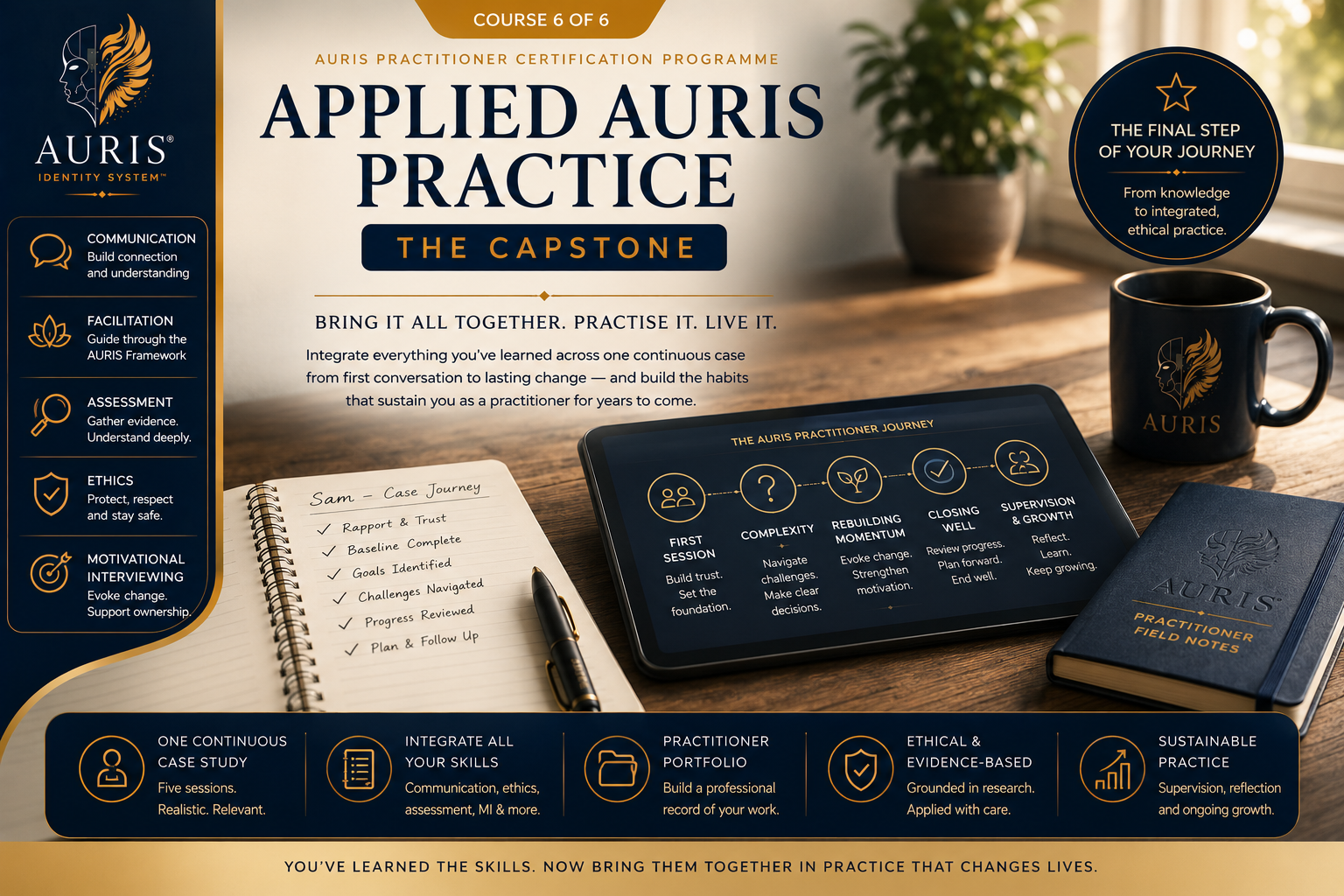
The capstone of the AURIS Practitioner Certification. Five lessons follow one continuous composite case, bringing communication, facilitation, assessment, ethics and motivational interviewing together, then turn to the supervision and reflective habits that sustain good practice over years.
What you'll leave with
You will have worked one full case from first session to honest follow-up, and written your own supervision and reflective practice plan.
Watch the course introduction
Watch this before you begin
Applied practice means working with real people, uncertainty and situations that do not arrive in neat textbook order. Amy Edmondson’s account of teaming under unfamiliar conditions is a useful reminder that good practice depends on curiosity, communication and learning while the work is happening. Watch for those behaviours before entering the applied scenarios.
Sold as part of the Practitioner Certification: £400 in full, or £50 a month for 8 months.
Course illustration
Suggested learning pathways
Where this course fits
- Where it sits
- Specialist learning that can be taken on its own, in any order.
- What usually comes before
- Nothing. This is a starting point, and the free Introduction to AURIS is always open alongside it.
- What usually comes next
- Whatever fits your situation. See the five pathways.
A pathway is a suggested order, not a requirement. Nothing here has to be bought to make this course work.
About this course and why it matters
About this course
The capstone course of the AURIS Practitioner Certification. Five lessons walk through one extended, composite case study, integrating communication, facilitation, assessment, ethics, and motivational interviewing skills from every course in this programme, followed by a lesson on supervision, reflective practice and your own ongoing development as a practitioner.
Why this matters
Skills learned course by course have to work together in one room, with one person, over several sessions. This is where that happens.
What you will learn
- Integrate communication, facilitation, assessment, ethics and motivational interviewing skills across one continuous case
- Plan and sequence a multi-session piece of work, not just a single conversation
- Navigate a realistic ethical dilemma and referral decision within an ongoing relationship
- Close a piece of work well, reviewing progress honestly rather than assuming success
- Build your own ongoing supervision and reflective practice as a working AURIS practitioner
Course curriculum · 5 lessons
Course curriculum
5 lessons. The lesson content itself opens once you start the course.
Lesson 1 · about 22 minutes
The First Session: Everything at Once
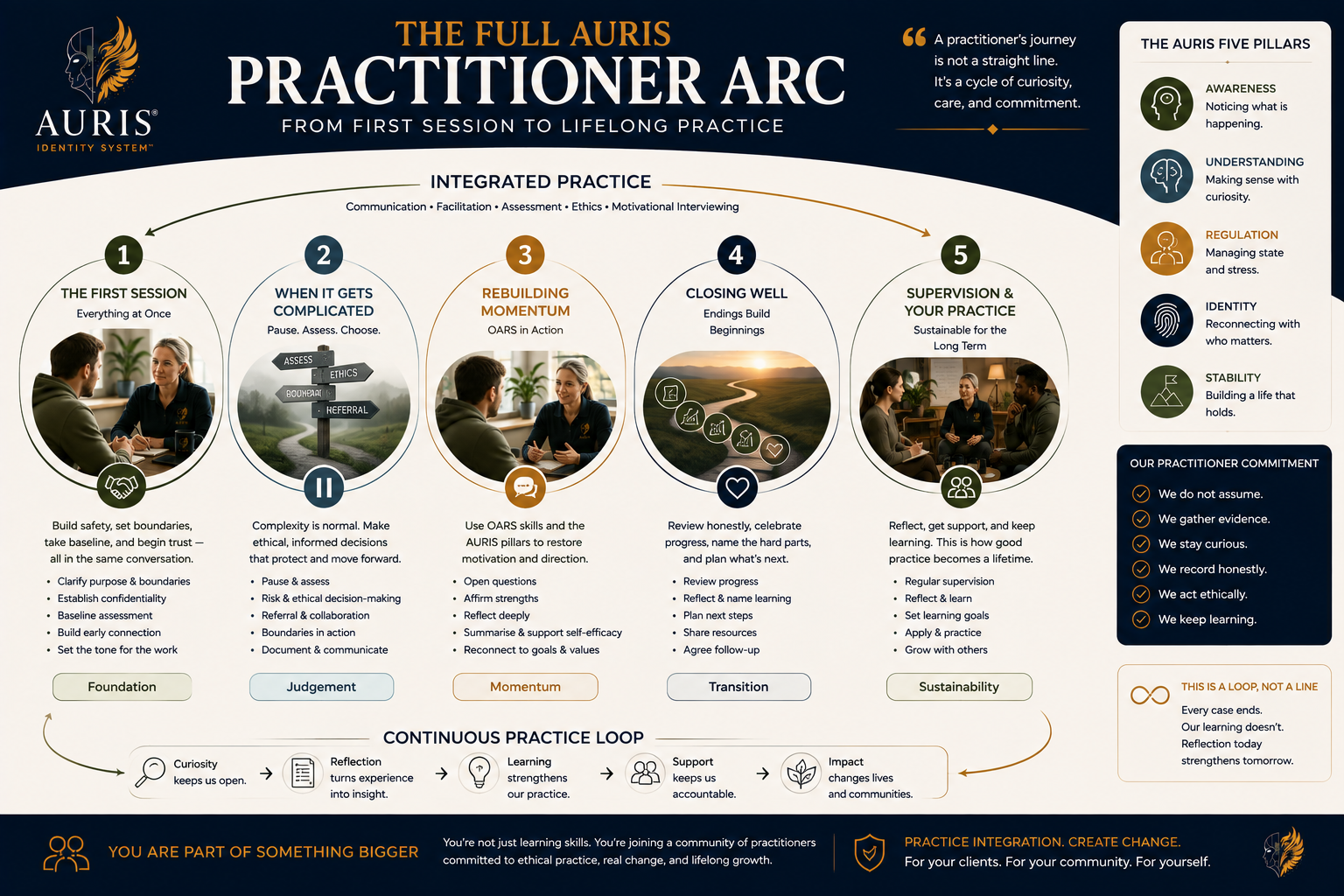
This lesson shows what it looks like when every skill from the previous five courses is running at the same time, in one realistic first session.
- Notice the skills from the previous courses running together in one session
- Set a boundary, take a baseline and reflect back within the same conversation
Lesson 2 · about 22 minutes
When It Gets Complicated
This lesson tests judgement under uncertainty: an ambiguous disclosure, right at the edge of scope, and a calm decision about routing.
- Read an ambiguous disclosure without panicking or dismissing it
- Make and record a considered decision about the routing threshold
Lesson 3 · about 22 minutes
Rebuilding Momentum
This lesson is about resisting the urge to fix, exactly when that urge is strongest, so the goal that emerges is genuinely theirs.
- Resist the righting reflex at the point of most fragility
- Use OARS to help someone arrive at their own goal
Lesson 4 · about 22 minutes
Closing Well
This lesson closes Sam's case honestly: a repeated baseline, a real follow-up date, and a Mechanism Reflection that captures what actually produced the movement.
- Close a piece of work by repeating the baseline rather than assuming success
- Write an honest Mechanism Reflection and set a genuine follow-up
Lesson 5 · about 22 minutes
Supervision and Your Ongoing Practice
This final lesson is about you: the supervision, reflective practice and development habits that carry you from one case to the next.
- Set your own supervision or peer consultation cadence
- Choose a reflective practice format and one area to keep developing
What is included
- Audio narration
- Guided reflections
- Interactive exercises
- Practical activities
- Downloadable worksheets
- Assessment
- Portfolio work
- Certificate on completion
Explore the course framework
The Full AURIS Practitioner Arc
Before you start
Complete the five earlier AURIS Practitioner Certification courses first: Identity-Centred Communication; Facilitating the AURIS Framework; Assessment, Formulation & Evidence Skills; Ethics, Boundaries & Safeguarding; and Motivational Interviewing & Goal Setting.
After you finish
After you finish
You will have worked one full case from first session to honest follow-up, and written your own supervision and reflective practice plan.
Common questions
How much does Applied AURIS Practice cost?
It is £30, paid once. You keep lifetime access to the course, including future research driven updates. There is no subscription or renewal.
Do I get a certificate?
Yes. Complete every lesson and pass the required assessment to receive an AURIS Certificate of Completion in your name. It records your learning. The separate Practitioner Certification is an internal AURIS programme; neither certificate is an externally accredited qualification or a clinical licence to practise.
How long does it take, and is it self-paced?
Study at your own pace. Lessons open in sequence after you complete the previous lesson; there is no daily waiting period for this course, and the course is designed to take about 110 minutes in total.
What work do I need to complete?
Lessons include practical activities and saved reflections. Some courses also require portfolio entries and an assessment; the lesson and assessment pages identify required work. Use ordinary or fictional examples where appropriate and avoid identifying details. Reading or listening alone does not complete a lesson.
Do I need to do anything before this course?
Complete the five earlier AURIS Practitioner Certification courses first: Identity-Centred Communication; Facilitating the AURIS Framework; Assessment, Formulation & Evidence Skills; Ethics, Boundaries & Safeguarding; and Motivational Interviewing & Goal Setting.
Next steps and related courses
Course progression
This is course 6 of 6 in the AURIS Institute Practitioner Certification.
- Foundation
- Applied
- Practitioner
Related courses
Previous course
Motivational Interviewing & Goal Setting
Course detailsProgramme
AURIS Practitioner Programme
See the programme
Evidence, sources and limitations
Research and evidence
This course integrates the AURIS-specific material from Facilitating the AURIS Framework and Assessment and Diagnostic Skills with the established external research from The Communication Reset and Motivational Interviewing and Goal Setting, applied together across one continuous composite case. Sam is an explicitly constructed teaching composite, not a real individual.
The evidence behind this course
Evidence
Building a practically useful theory of goal setting and task motivation — Locke and Latham, 2002 (Read source)
Specific, challenging goals produce better outcomes than vague ones, which is why goals are set concretely rather than aspirationally.
Narrative identity — McAdams, 2001 (Read source)
The narrative-identity basis for hearing the identity claim underneath what a composite client says, carried forward from Identity-Centred Communication.
How AURIS interprets it
- AURIS states that this capstone course integrates the AURIS-specific material from Facilitating the AURIS Framework and Assessment and Diagnostic Skills with the established external research from Identity-Centred Communication and Motivational Interviewing and Goal Setting, applied together across one continuous composite case that AURIS states plainly is a constructed teaching composite, not a real individual.
What you do with it
- You integrate communication, facilitation, assessment, ethics and motivational interviewing skills across one continuous case, and plan a multi-session piece of work rather than a single conversation.
- You close a piece of work by reviewing progress honestly, and build your own ongoing supervision and reflective practice.
Ready to begin?
This course is part of the Practitioner Certification: £400 in full, or £50 a month for 8 months.