
Motivational Interviewing & Goal Setting
Listen deeply. Evoke change. Set goals that hold.
By the end you will be able to use the four core motivational interviewing skills to help someone find their own reasons to change.
Part of the AURIS approach to identity, stability and human development.
- Professional
- Practitioner Certification · £400
- Practitioner Certification
- Course 5 of 6
- About 100 minutes
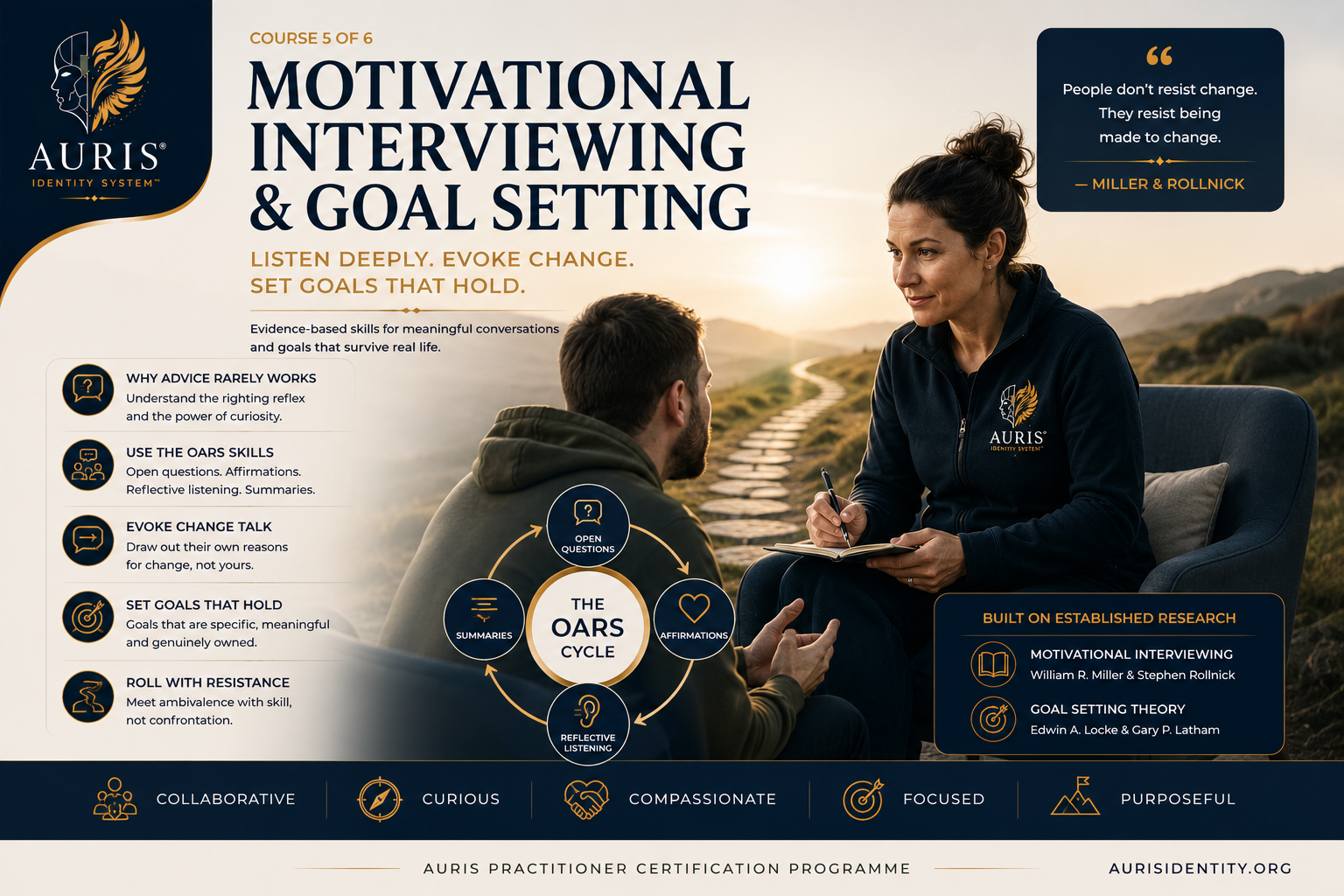
Why advice rarely changes behaviour, and what actually does. Learn the four core skills of motivational interviewing, how to listen for someone's own reasons for change, and how to help them set a goal that survives contact with real life.
What you'll leave with
Before You Speak In the moment, ask yourself: - Am I about to solve? - Am I about to advise? - Or am I about to understand? Use this every time you feel the urge to jump in, for the rest of this course and beyond.
Watch the course introduction
Watch this before you begin
Motivational interviewing is not persuasive advice. It depends on listening closely enough for the person’s own reasons, ambivalence and language for change to emerge. Use this short talk as a listening primer before learning OARS, change talk and the discipline of resisting the urge to fix.
Sold as part of the Practitioner Certification: £400 in full, or £50 a month for 8 months.
Course illustration
Suggested learning pathways
Where this course fits
- Where it sits
- Specialist learning that can be taken on its own, in any order.
- What usually comes before
- Nothing. This is a starting point, and the free Introduction to AURIS is always open alongside it.
- What usually comes next
- Whatever fits your situation. See the five pathways.
A pathway is a suggested order, not a requirement. Nothing here has to be bought to make this course work.
About this course and why it matters
About this course
A five-lesson practitioner course on motivational interviewing and goal setting, built on the established, evidenced methods of Miller and Rollnick, and Locke and Latham. Covers why direct advice tends to backfire, the four core listening skills of motivational interviewing, listening for and evoking someone's own reasons for change, and setting goals specific and challenging enough to actually hold.
Why this matters
Most practitioners are trained to help by explaining, suggesting and solving. The evidence says that rarely changes behaviour. What changes behaviour is helping someone hear their own reasons for change, and then setting a goal they genuinely own.
What you will learn
- Recognise the fixing reflex and offer advice collaboratively with permission
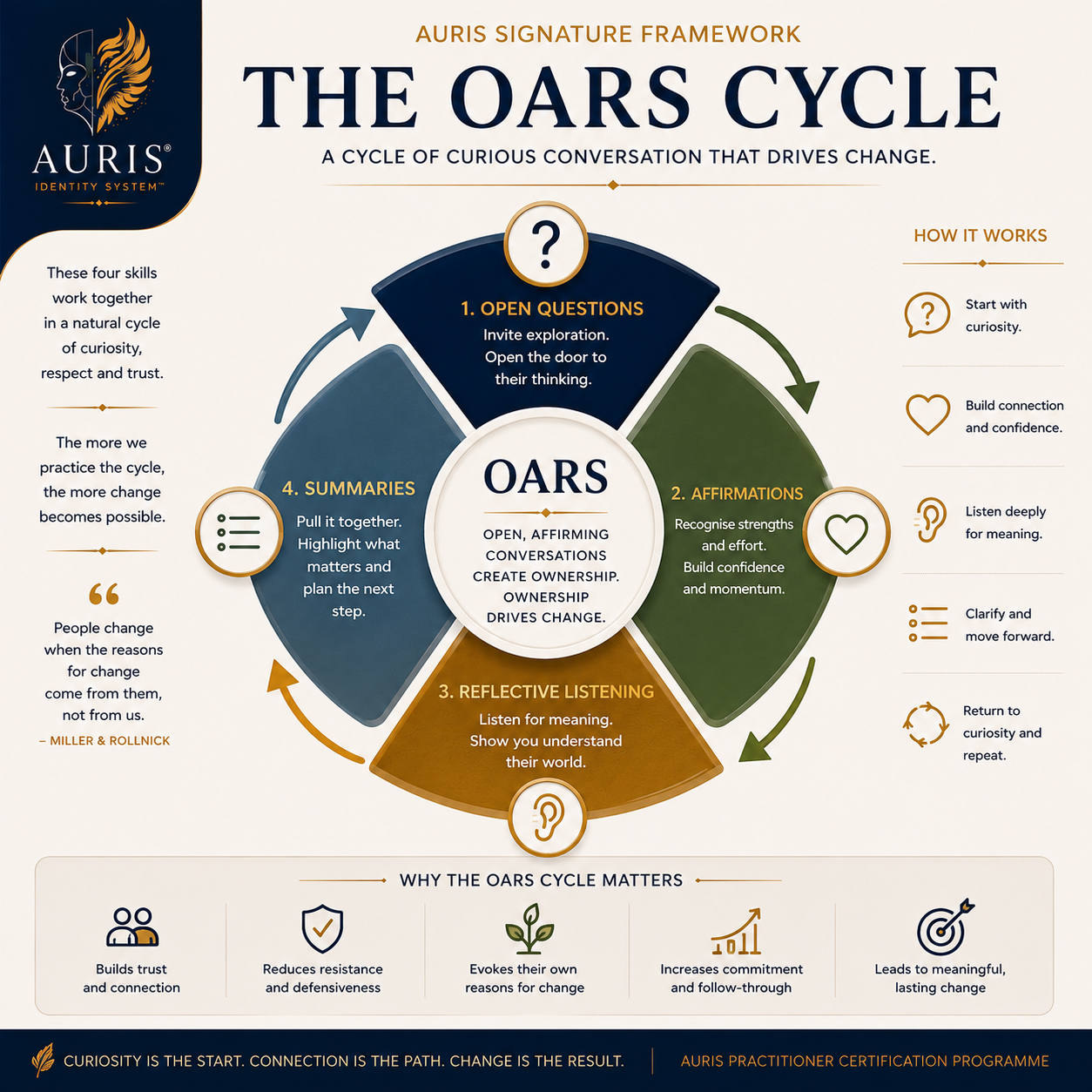
- Use open questions, affirmations, reflective listening and summaries
- Distinguish change talk, sustain talk and discord without labelling the person resistant
- Help someone choose a feasible goal with an observable next step
- Respond to ambivalence and relationship strain while respecting autonomy
Course curriculum · 5 lessons
Course curriculum
5 lessons. The lesson content itself opens once you start the course.
Lesson 1 · about 20 minutes
Why Advice Doesn't Work
This lesson names the fixing reflex, the instinct to advise, and why curiosity works where advice does not.
- Recognise the fixing reflex (historically called the righting reflex) in your own practice
- Ask permission before offering advice and check the person’s response
Lesson 2 · about 20 minutes
The Four Core Skills: OARS
This lesson gives you the four core motivational interviewing skills that replace advice.
- Use open questions, affirmations, reflective listening and summaries
- Use a reflective statement in place of a question
Lesson 3 · about 20 minutes
Change Talk vs Sustain Talk
This lesson is about what to listen for: change talk, and how reflecting it back strengthens it.
- Tell change talk apart from sustain talk
- Reflect change talk back rather than arguing against sustain talk
Lesson 4 · about 20 minutes
Setting Goals That Actually Hold
This lesson is about setting a goal specific enough to act on and genuinely owned enough to hold.
- Describe a feasible goal with an observable next step
- Use an ownership rating as a conversation prompt, not a validated scale
Lesson 5 · about 20 minutes
Working With Sustain Talk and Discord
This lesson is about distinguishing sustain talk from discord and responding with curiosity, partnership and autonomy rather than treating the person as resistant.
- Expect ambivalence to resurface as a normal pattern
- Respond to a defensive reply with curiosity
What is included
- Audio narration
- Guided reflections
- Interactive exercises
- Practical activities
- Downloadable worksheets
- Assessment
- Portfolio work
- Certificate on completion
Explore the course framework
The OARS Cycle
Before you start
Complete Identity-Centred Communication; Facilitating the AURIS Framework; Assessment, Formulation & Evidence Skills; and Ethics, Boundaries & Safeguarding first.
After you finish
After you finish
Before You Speak In the moment, ask yourself: - Am I about to solve? - Am I about to advise? - Or am I about to understand? Use this every time you feel the urge to jump in, for the rest of this course and beyond.
Common questions
How much does Motivational Interviewing & Goal Setting cost?
It is £20, paid once. You keep lifetime access to the course, including future research driven updates. There is no subscription or renewal.
Do I get a certificate?
Yes. Complete every lesson and pass the required assessment to receive an AURIS Certificate of Completion in your name. It records your learning. The separate Practitioner Certification is an internal AURIS programme; neither certificate is an externally accredited qualification or a clinical licence to practise.
How long does it take, and is it self-paced?
Study at your own pace. Lessons open in sequence after you complete the previous lesson; there is no daily waiting period for this course, and the course is designed to take about 100 minutes in total.
What work do I need to complete?
Lessons include practical activities and saved reflections. Some courses also require portfolio entries and an assessment; the lesson and assessment pages identify required work. Use ordinary or fictional examples where appropriate and avoid identifying details. Reading or listening alone does not complete a lesson.
Do I need to do anything before this course?
Complete Identity-Centred Communication; Facilitating the AURIS Framework; Assessment, Formulation & Evidence Skills; and Ethics, Boundaries & Safeguarding first.
Next steps and related courses
Course progression
This is course 5 of 6 in the AURIS Institute Practitioner Certification.
- Foundation
- Applied
- Practitioner
Course 5 of 6 in the AURIS Practitioner Programme. Next is Applied AURIS Practice, the capstone course where every skill from the programme comes together in supervised delivery.
Related courses
Previous course
Ethics, Boundaries & Safeguarding
Course detailsNext course
Applied AURIS Practice
Course detailsProgramme
AURIS Practitioner Programme
See the programme
Evidence, sources and limitations
Research and evidence
This course draws on established, evidenced external research: William Miller and Stephen Rollnick's Motivational Interviewing, and Edwin Locke and Gary Latham's goal-setting theory, applied through the AURIS Framework. Like The Communication Reset, this content is not drawn from AURIS's own interview research. That distinction is stated plainly, the same honest-sourcing standard used throughout the rest of the Academy.
The evidence behind this course
Evidence
Motivational Interviewing — Miller and Rollnick
Direct advice tends to provoke resistance; evoking a person's own reasons for change is more effective than arguing for it.
Building a practically useful theory of goal setting and task motivation — Locke and Latham, 2002 (Read source)
Specific, challenging goals produce better outcomes than vague ones, which is why goals are set concretely rather than aspirationally.
How AURIS interprets it
- AURIS states plainly that, like Identity-Centred Communication, this course is not drawn from AURIS's own interview research; it applies Miller and Rollnick's and Locke and Latham's established methods through the AURIS Framework.
What you do with it
- You use the four core motivational interviewing skills (open questions, affirmations, reflective listening, summaries) and recognise and evoke change talk rather than arguing for change.
- You help someone set a goal that is specific and genuinely chosen, and practise rolling with resistance rather than confronting it directly.
Ready to begin?
This course is part of the Practitioner Certification: £400 in full, or £50 a month for 8 months.