
Ethics, Boundaries & Safeguarding
Part of the AURIS approach to identity, stability and human development.
- Professional
- Practitioner Certification · £400
- Practitioner Certification
- Course 4 of 6
- About 100 minutes
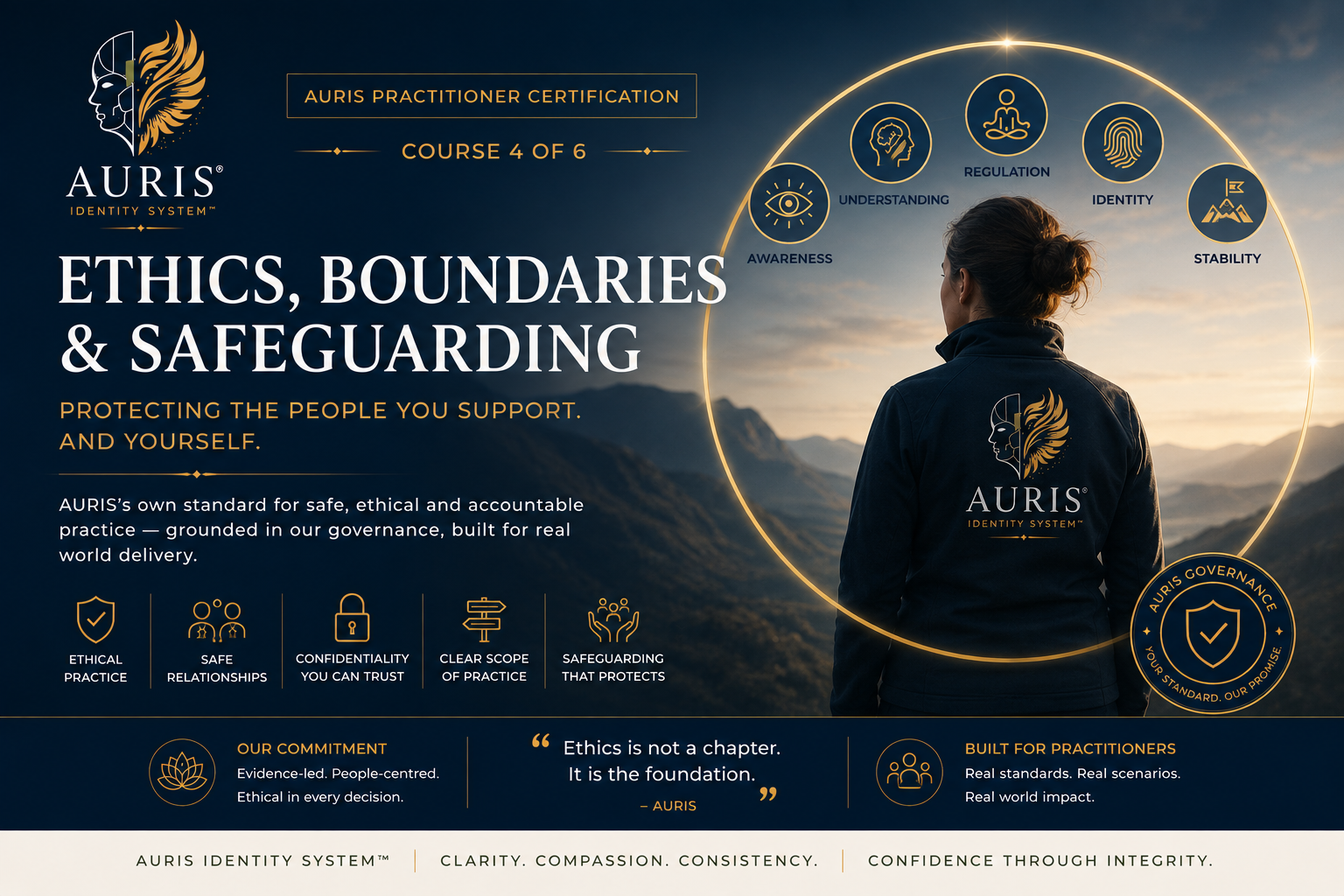
The ethical foundation of AURIS practice: boundaries, confidentiality and its limits, scope of practice, recognising risk and referring on, and the daily habits that hold it all together.
What you'll leave with
Professional Practice Checklist Before every session: - I am regulated and present. - I know today's objective. - I know today's boundaries. - This work is within my scope. - I would be comfortable documenting today's decisions. During every session: - I stay in scope and signpost anything outside it. - I notice changes in behaviour, language and context. - I ask calm, clarifying questions when something concerns me. - I do not promise secrecy where someone may be at risk. After every session: - I record facts, not opinions. - I route any concern to my safeguarding lead. - I reflect on what worked and what did not. - I seek supervision or support when I need it.
Watch the course introduction
Watch this before you begin
Boundaries are not an optional extra in practitioner work. They protect the learner, the practitioner and the integrity of the relationship. Nedra Glover Tawwab gives a concise practical way to think about setting limits; watch it before we move into confidentiality, scope, safeguarding and referral.
Sold as part of the Practitioner Certification: £400 in full, or £50 a month for 8 months.
Course illustration
Suggested learning pathways
Where this course fits
- Where it sits
- Specialist learning that can be taken on its own, in any order.
- What usually comes before
- Nothing. This is a starting point, and the free Introduction to AURIS is always open alongside it.
- What usually comes next
- Whatever fits your situation. See the five pathways.
A pathway is a suggested order, not a requirement. Nothing here has to be bought to make this course work.
About this course and why it matters
About this course
Ethical practice is rarely built in dramatic moments. It is built through hundreds of ordinary decisions made consistently. This course gives you the AURIS ethical foundation in five lessons: how to hold professional boundaries, what confidentiality means and where it ends, where AURIS coaching stops and clinical care begins, how to recognise risk and route it rather than carry it, and how to turn all of it into daily habits you can keep. It is drawn from AURIS governance policy and is required for every AURIS practitioner.
Why this matters
People only share what they believe you will respect and protect. Boundaries, confidentiality and scope are what make that trust possible, and safeguarding is what keeps it safe. Without this foundation, everything else in AURIS practice becomes risky.
What you will learn
- Explain professional boundaries and make a reasoned decision about a request
- Explain confidentiality and its legal and safeguarding qualifications under the applicable procedure
- Work within actual competence, qualifications, insurance and role
- Recognise concerns and follow the appropriate safeguarding, emergency or referral route without claiming clinical risk assessment
- Use records, supervision and continuing development to review ethical decisions
Course curriculum · 5 lessons
Course curriculum
5 lessons. The lesson content itself opens once you start the course.
Lesson 1 · about 20 minutes
Professional Boundaries
This lesson is about holding clear professional boundaries, and why a boundary protects the relationship rather than distancing it.
- Hold a clear professional boundary and say why it exists
- Recognise the small, ordinary requests that test a boundary first
Lesson 2 · about 20 minutes
Confidentiality and Its Limits
This lesson is about what confidentiality can and cannot promise, including safeguarding, legal, contractual and organisational limits that must be explained before they are tested.
- Explain confidentiality in plain language before you begin working with someone
- Name the four situations where the safeguarding override applies
Lesson 3 · about 20 minutes
Scope of Practice
This lesson is about knowing exactly where AURIS coaching ends, and what to do when the work in front of you belongs to someone else.
- State clearly what is inside and outside AURIS scope
- Use the scope check to decide whether to continue or route on
Lesson 4 · about 20 minutes
Recognising Risk and Referring On
This lesson is about noticing risk early and routing it properly, rather than carrying it on your own.
- Recognise early behavioural, verbal and contextual signs of risk
- Follow the AURIS risk response pathway and document it honestly
Lesson 5 · about 20 minutes
Holding It All Together
This lesson is about turning the ethical foundation into a routine you can actually hold, session after session.
- Run the AURIS ethical practice cycle across a session
- Build a small ethical routine you can keep on a bad week
What is included
- Audio narration
- Guided reflections
- Interactive exercises
- Practical activities
- Downloadable worksheets
- Assessment
- Portfolio work
- Certificate on completion
Before you start
Complete Identity-Centred Communication; Facilitating the AURIS Framework; and Assessment, Formulation & Evidence Skills first.
After you finish
After you finish
Professional Practice Checklist Before every session: - I am regulated and present. - I know today's objective. - I know today's boundaries. - This work is within my scope. - I would be comfortable documenting today's decisions. During every session: - I stay in scope and signpost anything outside it. - I notice changes in behaviour, language and context. - I ask calm, clarifying questions when something concerns me. - I do not promise secrecy where someone may be at risk. After every session: - I record facts, not opinions. - I route any concern to my safeguarding lead. - I reflect on what worked and what did not. - I seek supervision or support when I need it.
Common questions
How much does Ethics, Boundaries & Safeguarding cost?
It is £20, paid once. You keep lifetime access to the course, including future research driven updates. There is no subscription or renewal.
Do I get a certificate?
Yes. Complete every lesson and pass the required assessment to receive an AURIS Certificate of Completion in your name. It records your learning. The separate Practitioner Certification is an internal AURIS programme; neither certificate is an externally accredited qualification or a clinical licence to practise.
How long does it take, and is it self-paced?
Study at your own pace. Lessons open in sequence after you complete the previous lesson; there is no daily waiting period for this course, and the course is designed to take about 100 minutes in total.
What work do I need to complete?
Lessons include practical activities and saved reflections. Some courses also require portfolio entries and an assessment; the lesson and assessment pages identify required work. Use ordinary or fictional examples where appropriate and avoid identifying details. Reading or listening alone does not complete a lesson.
Do I need to do anything before this course?
Complete Identity-Centred Communication; Facilitating the AURIS Framework; and Assessment, Formulation & Evidence Skills first.
Next steps and related courses
Course progression
This is course 4 of 6 in the AURIS Institute Practitioner Certification.
- Foundation
- Applied
- Practitioner
Course 4 of 6 in the AURIS Practitioner Programme. Next is Motivational Interviewing and Goal Setting, then Applied AURIS Practice, where you take all of this into supervised delivery.
Related courses
Previous course
Assessment, Formulation & Evidence Skills
Course detailsNext course
Motivational Interviewing & Goal Setting
Course detailsProgramme
AURIS Practitioner Programme
See the programme
Evidence, sources and limitations
Research and evidence
Sourced from AURIS governance policy AURIS-GOV-POL-060 (Ethics and Professional Boundaries) and AURIS-GOV-POL-062 (Safeguarding and Risk Response). Where a case is described it is a composite consistent with AURIS pilot delivery. No participant names, quotes or timestamps are used.
The evidence behind this course
Evidence
Ethics and Professional Boundaries (AURIS-GOV-POL-060) — AURIS governance
The professional boundaries and confidentiality standard every AURIS practitioner works to.
Safeguarding and Risk Response (AURIS-GOV-POL-062) — AURIS governance
The safeguarding and risk-response pathway a practitioner follows when a conversation reveals risk of harm.
How AURIS interprets it
- AURIS is explicit that this course is sourced from its own governance policy, not external research, because it teaches an operational standard rather than a psychological finding.
What you do with it
- You hold professional boundaries, explain confidentiality and its safeguarding override in plain language, and know where AURIS coaching ends and clinical care begins.
- You recognise early signs of risk and route them through the AURIS risk response pathway rather than carrying them yourself.
Ready to begin?
This course is part of the Practitioner Certification: £400 in full, or £50 a month for 8 months.