
Assessment, Formulation & Evidence Skills
Part of the AURIS approach to identity, stability and human development.
- Professional
- Practitioner Certification · £400
- Practitioner Certification
- Course 3 of 6
- About 175 minutes
How AURIS actually assesses where someone is, using the same baseline method, markers and honesty discipline used in AURIS's own pilot delivery, not a generic coaching assessment framework borrowed from elsewhere.
Watch the course introduction
Watch this before you begin
Good assessment starts with the possibility that our first explanation may be wrong. Alex Edmans shows how confirmation bias can distort what we accept as evidence and offers practical ways to test what we think we know. Watch for the discipline of looking for disconfirming evidence; you will use that mindset throughout this course.
Sold as part of the Practitioner Certification: £400 in full, or £50 a month for 8 months.
Course illustration
Suggested learning pathways
Where this course fits
- Where it sits
- Specialist learning that can be taken on its own, in any order.
- What usually comes before
- Nothing. This is a starting point, and the free Introduction to AURIS is always open alongside it.
- What usually comes next
- Whatever fits your situation. See the five pathways.
A pathway is a suggested order, not a requirement. Nothing here has to be bought to make this course work.
About this course and why it matters
About this course
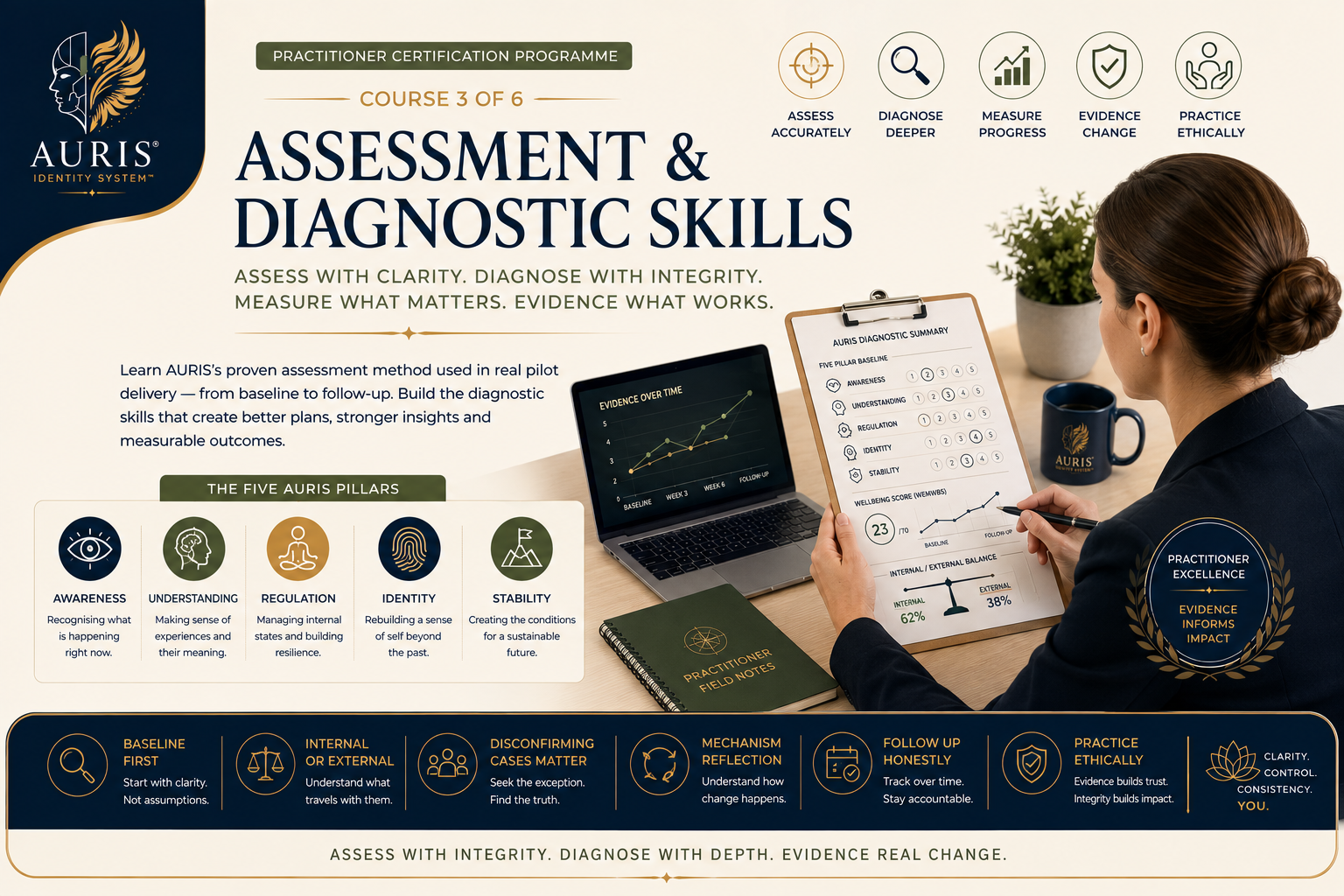
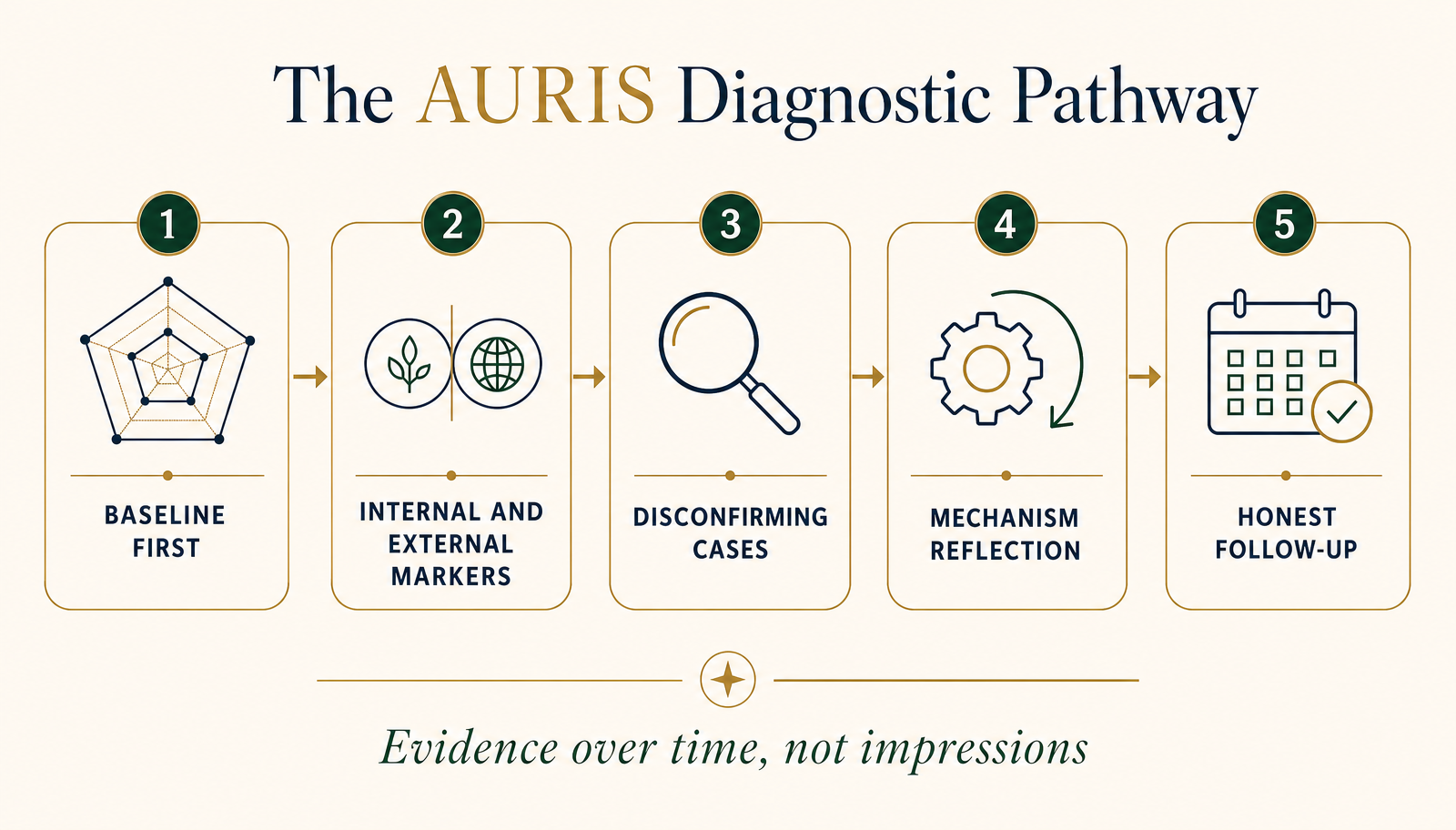
A five-lesson practitioner course built directly on AURIS's own real assessment practice: baseline measurement before any work begins, marking regulation strategies as internal or external, deliberately recording disconfirming cases rather than only confirming ones, capturing the mechanism of change rather than just whether it happened, and following up honestly over time.
Why this matters
Good support starts with knowing honestly where someone actually is. This course teaches the real assessment method AURIS uses in its own pilot delivery, so your plans are built on evidence rather than impression.
What you will learn
- Take a proper baseline before any plan is made, the same way AURIS does in pilot delivery
- Mark regulation strategies as internal or external, and recognise over-reliance on one external factor
- Actively look for disconfirming cases, not just evidence that confirms what you expect to find
- Capture the mechanism of change, not just whether a shift happened
- Follow up honestly over time, without overclaiming what a short assessment can actually tell you
Course curriculum · 5 lessons
Course curriculum
5 lessons. The lesson content itself opens once you start the course.
Lesson 1 · about 35 minutes
Baseline First
AURIS stage: Awareness. This lesson makes you able to take a structured five pillar baseline with another person, in their words, and to keep what they reported separate from what you concluded.
- Open, run and close a first baseline conversation with one person
- Record what the person reported separately from your own reading of it
- State what routine measurement does and does not tell a practitioner
Lesson 2 · about 35 minutes
The Internal/External Marker
AURIS stage: Regulation, with a secondary connection to Stability. This lesson makes you able to hear the regulation strategies another person names, mark where each one is held, and respond without telling them their coping is wrong.
- Elicit the regulation strategies a person actually uses, in their own words
- Mark each strategy by where it is held and say what that does and does not tell you
- Raise a fragile strategy with the person without judging their coping
Lesson 3 · about 35 minutes
Disconfirming Cases Matter
AURIS stage: Understanding, with a secondary connection to Awareness. This lesson makes you able to state your working read of another person as a testable question, then go looking for the case and the questions that would show you are wrong.
- State a working read as a testable question rather than a conclusion
- Design the question or observation that would disconfirm your own read
- Record exceptions with the same care as confirmations
Lesson 4 · about 35 minutes
Mechanism Reflection
AURIS stage: Understanding, with a secondary connection to Identity. This lesson makes you able to ask another person what actually produced a change, record their account of the mechanism, and say plainly what your record does and does not establish.
- Ask a person what produced a change without supplying the answer
- Separate the result, the person's explanation and your own inference in a record
- State what a single case can and cannot establish about a mechanism
Lesson 5 · about 35 minutes
Following Up Honestly
AURIS stage: Stability, with a secondary connection to Identity. This lesson makes you able to run a follow up conversation that gets an honest answer, and to state a claim about a person's progress that is no bigger than the evidence you hold.
- Run a follow up conversation that makes an honest answer easier than a polite one
- Explain why a later self rating is not always comparable with the baseline
- State a claim about outcome that matches the evidence you actually have
What is included
- Audio narration
- Guided reflections
- Interactive exercises
- Practical activities
- Downloadable worksheets
- Assessment
- Portfolio work
- Certificate on completion
Explore the course framework
The AURIS Diagnostic Pathway
Before you start
Complete Identity-Centred Communication and Facilitating the AURIS Framework first.
After you finish
Common questions
How much does Assessment, Formulation & Evidence Skills cost?
It is £30, paid once. You keep lifetime access to the course, including future research driven updates. There is no subscription or renewal.
Do I get a certificate?
Yes. Complete every lesson and pass the required assessment to receive an AURIS Certificate of Completion in your name. It records your learning. The separate Practitioner Certification is an internal AURIS programme; neither certificate is an externally accredited qualification or a clinical licence to practise.
How long does it take, and is it self-paced?
Study at your own pace. Lessons open in sequence after you complete the previous lesson; there is no daily waiting period for this course, and the course is designed to take about 175 minutes in total.
What work do I need to complete?
Lessons include practical activities and saved reflections. Some courses also require portfolio entries and an assessment; the lesson and assessment pages identify required work. Use ordinary or fictional examples where appropriate and avoid identifying details. Reading or listening alone does not complete a lesson.
Do I need to do anything before this course?
Complete Identity-Centred Communication and Facilitating the AURIS Framework first.
Next steps and related courses
Course progression
This is course 3 of 6 in the AURIS Institute Practitioner Certification.
- Foundation
- Applied
- Practitioner
Related courses
Previous course
Facilitating the AURIS Framework
Course detailsNext course
Ethics, Boundaries & Safeguarding
Course detailsProgramme
AURIS Practitioner Programme
See the programme
Evidence, sources and limitations
Research and evidence
This course is built directly on AURIS's own real assessment method, as used in its own pilot delivery: baseline measurement, the Internal/External regulation marker, the discipline of recording disconfirming cases, and Mechanism Reflection (from AURIS's Workshop Cohort Sheets and Facilitator Data Collection Checklist). This is AURIS's own real practice, not a borrowed external framework.
The evidence behind this course
Evidence
Response shift in health related quality of life research — Sprangers and Schwartz, 1999
A person's internal standards and understanding of a question can change after a significant life change, so a later self rating is not always measured against the same baseline.
Demand characteristics — Nichols and Maner, 2008
Participants who identify what a researcher expects tend to behave in the direction that confirms it, a caution for follow up conversations where a warm relationship increases the pull to give a pleasing answer.
How AURIS interprets it
- AURIS is explicit that this course is built on its own real assessment method used in pilot delivery (baseline measurement, the internal/external regulation marker, deliberately recording disconfirming cases, and mechanism reflection), not a borrowed external framework.
- AURIS applies the response shift and demand characteristics research as a caution against overclaiming a follow up conversation as proof that something worked.
What you do with it
- You take a baseline before any plan is made, mark regulation strategies as internal or external, and actively record disconfirming cases rather than only confirming ones.
- You run a follow up conversation designed to make an honest answer easier than a polite one, and write a claim about someone's progress no larger than the evidence you hold.
Ready to begin?
This course is part of the Practitioner Certification: £400 in full, or £50 a month for 8 months.