
Facilitating the AURIS Framework
Part of the AURIS approach to identity, stability and human development.
- Professional
- Practitioner Certification · £400
- Practitioner Certification
- Course 2 of 6
- About 125 minutes
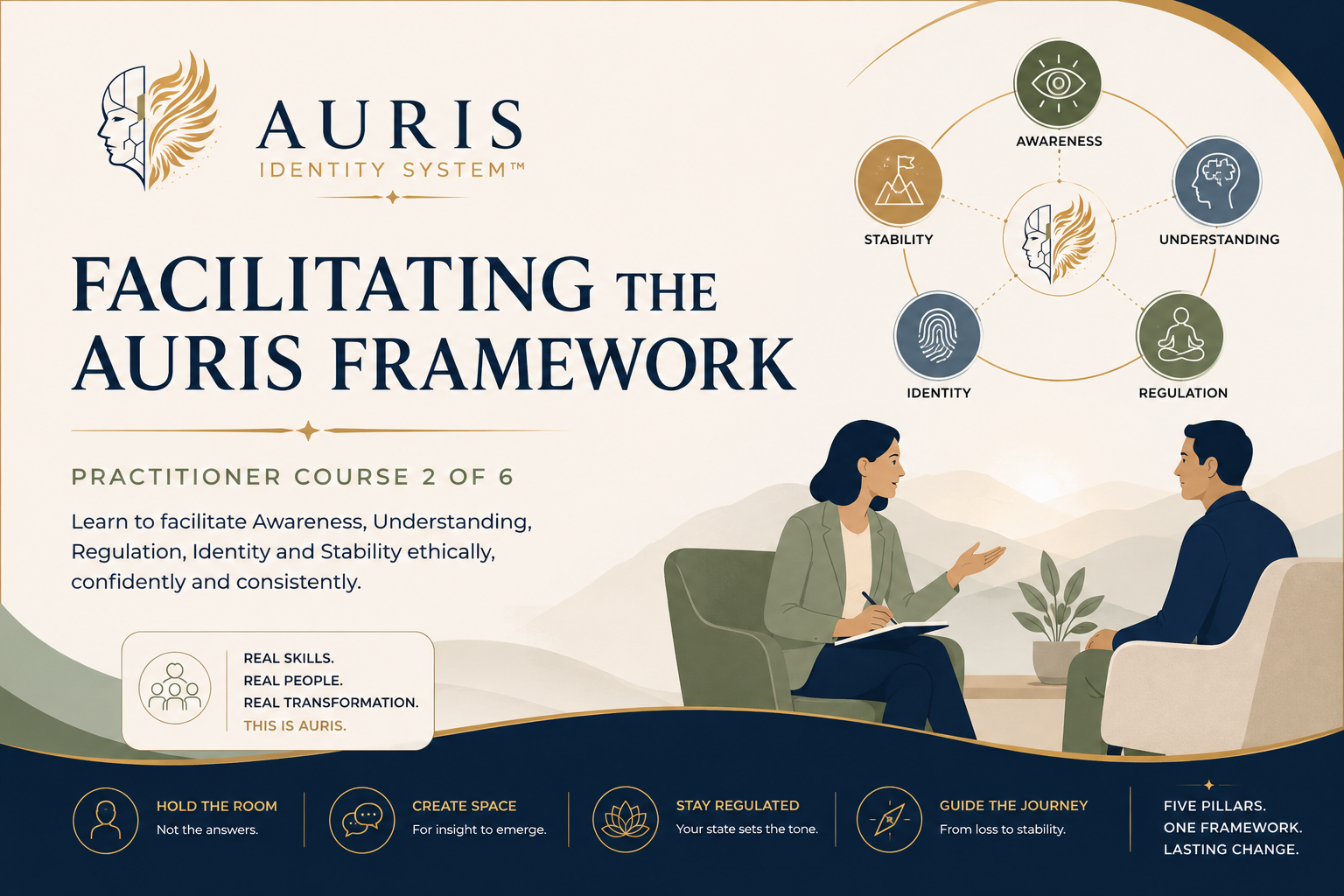
How to actually facilitate the five AURIS pillars for someone else: the real teaching points, exercises and anchors AURIS already uses in live delivery, adapted for one-to-one practitioner work.
What you'll leave with
You finish with your Session Plan: five stages, your own opening words, your own prompts, your pacing script, your exit and return protocol, and your closing commitment question. You will be able to say what the published evidence supports and where AURIS practice goes further. Course 3 then asks how you assess and record what you are seeing.
Watch the course introduction
Watch this before you begin
Facilitation is not performing at a group; it is creating the conditions in which people can think, contribute and work safely together. Amy Edmondson explores how psychological safety and shared purpose help unfamiliar people become an effective team. Watch for what the facilitator makes possible rather than what they personally control.
Sold as part of the Practitioner Certification: £400 in full, or £50 a month for 8 months.
Course illustration
Suggested learning pathways
Where this course fits
- Where it sits
- Specialist learning that can be taken on its own, in any order.
- What usually comes before
- Nothing. This is a starting point, and the free Introduction to AURIS is always open alongside it.
- What usually comes next
- Whatever fits your situation. See the five pathways.
A pathway is a suggested order, not a requirement. Nothing here has to be bought to make this course work.
About this course and why it matters
About this course
A five-lesson practitioner course, one lesson per pillar, built directly on AURIS's own Facilitator Guides. Covers the real exercise and anchor for each stage, plus the facilitation skill underneath it: holding the room rather than fixing, asking questions that create space rather than supplying answers, and staying regulated yourself as a precondition for helping someone else.
Why this matters
Knowing the five pillars is not the same as being able to facilitate them for another person. This course teaches the facilitation itself: how you open a stage, what you say when nobody speaks, what you do when somebody says too much, how you pace a regulation practice, and how you close a session so the person leaves with something they will actually do. You finish holding a written Session Plan you can run, in your own words.
What you will learn
- Facilitate each of the five AURIS pillar stages with one person, from opening words to close
- Hold silence, over-disclosure, disengagement and competing status in a facilitated session
- Ask questions that open meaning without supplying the meaning yourself
- Build a complete written session plan you can run, with your own wording and timings
- State plainly what the published evidence supports and where AURIS practice goes beyond it
Course curriculum · 5 lessons
Course curriculum
5 lessons. The lesson content itself opens once you start the course.
Lesson 1 · about 25 minutes
Facilitating Awareness: Name It to Tame It
AURIS stage: Awareness. This lesson makes you able to introduce, run and close AURIS's Name It to Tame It exercise with one person, and to hold the silence afterwards without naming the thing for them.
- Introduce, run and close the Name It to Tame It exercise with one person
- Respond to silence and to over-disclosure without supplying the answer
- State what published affect labelling research does and does not support
Lesson 2 · about 25 minutes
Facilitating Understanding: The Story With Meaning
AURIS stage: Understanding. This lesson makes you able to move a person from the events of what happened to what those events gave them, using your questions, without putting your own meaning into their account.
- Choose and justify the next facilitation move when a person stops at chronology
- Write questions that open meaning without proposing the meaning yourself
- State the difference between published meaning-making evidence and AURIS's emerging interview pattern
Lesson 3 · about 25 minutes
Facilitating Regulation: Body Before Mind
AURIS stage: Regulation. This lesson makes you able to lead a slow breathing practice with another person, regulate yourself first, and respond to refusal without turning it into a confrontation.
- Lead a slow paced breathing practice with another person, in your own words
- Respond to refusal or visible discomfort without pressure or persuasion
- State what breathing and co-regulation research supports, without overclaiming
Lesson 4 · about 25 minutes
Facilitating Identity: I Am, Not I Was
AURIS stage: Identity. This lesson makes you able to facilitate a person moving from I was to I am, in their own words, without proposing a new identity for them and without deleting the old one.
- Facilitate a person moving from past tense to present tense self description
- Respond to an identity claim that is inflated, borrowed or self-deprecating, without correcting it
- State what possible selves and identity continuity research supports and where AURIS application begins
Lesson 5 · about 25 minutes
Facilitating Stability: Routine, Standards, Connection
AURIS stage: Stability. This lesson makes you able to help a person turn an identity claim into a small repeatable action, and to close a session safely so nobody leaves opened up with nowhere to go.
- Help a person convert an identity claim into one specific, cued, repeatable action
- Close a session so that nobody leaves opened up without a next step
- Run the full five stage session from your completed Session Plan
What is included
- Audio narration
- Guided reflections
- Interactive exercises
- Practical activities
- Downloadable worksheets
- Assessment
- Portfolio work
- Certificate on completion
Before you start
Course 2 of 6 in the AURIS Practitioner Certification. Complete Identity-Centred Communication first. It assumes you can already hear an identity claim, notice overload, and state a referral threshold.
After you finish
After you finish
You finish with your Session Plan: five stages, your own opening words, your own prompts, your pacing script, your exit and return protocol, and your closing commitment question. You will be able to say what the published evidence supports and where AURIS practice goes further. Course 3 then asks how you assess and record what you are seeing.
Common questions
How much does Facilitating the AURIS Framework cost?
It is £30, paid once. You keep lifetime access to the course, including future research driven updates. There is no subscription or renewal.
Do I get a certificate?
Yes. Complete every lesson and pass the required assessment to receive an AURIS Certificate of Completion in your name. It records your learning. The separate Practitioner Certification is an internal AURIS programme; neither certificate is an externally accredited qualification or a clinical licence to practise.
How long does it take, and is it self-paced?
Study at your own pace. Lessons open in sequence after you complete the previous lesson; there is no daily waiting period for this course, and the course is designed to take about 125 minutes in total.
What work do I need to complete?
Lessons include practical activities and saved reflections. Some courses also require portfolio entries and an assessment; the lesson and assessment pages identify required work. Use ordinary or fictional examples where appropriate and avoid identifying details. Reading or listening alone does not complete a lesson.
Do I need to do anything before this course?
Course 2 of 6 in the AURIS Practitioner Certification. Complete Identity-Centred Communication first. It assumes you can already hear an identity claim, notice overload, and state a referral threshold.
Next steps and related courses
Course progression
This is course 2 of 6 in the AURIS Institute Practitioner Certification.
- Foundation
- Applied
- Practitioner
This is course 2 of 6 in the AURIS Practitioner Certification.
Related courses
Previous course
Identity-Centred Communication
Course detailsNext course
Assessment, Formulation & Evidence Skills
Course detailsProgramme
AURIS Practitioner Programme
See the programme
Evidence, sources and limitations
Research and evidence
This course teaches AURIS's own facilitation method, taken from the Facilitator Guides (AURIS-PROG-FAC-073) and the Facilitator Training and Onboarding standard (AURIS-PROG-TRN-017). That is AURIS operational material: real delivery practice, not research findings. Alongside it, this course names the published research that supports the underlying psychological principles the method relies on. Those sources support the principles. They do not test or validate the AURIS Framework, and this course does not claim that they do. Where AURIS practice goes beyond what the evidence establishes, it is labelled as AURIS practice. Verified sources used across the five lessons: Lieberman and colleagues (2007), affect labelling and reduced amygdala response, https://doi.org/10.1111/j.1467-9280.2007.01916.x Kircanski, Lieberman and Craske (2012), labelling during exposure, https://doi.org/10.1177/0956797612443830 Torre and Lieberman (2018), affect labelling as implicit emotion regulation, and its limits, https://doi.org/10.1177/1754073917742706 Haslam and colleagues (2008), social identity, health and wellbeing, https://doi.org/10.1111/j.1464-0597.2008.00379.x Iyer and colleagues (2009), multiple group memberships and adjustment after life transitions, https://doi.org/10.1348/014466608X397628 Rowe (1986), wait time in questioning, https://doi.org/10.1177/002248718603700110 Park (2010), meaning making and adjustment, https://doi.org/10.1037/a0018301 Heritage and colleagues (2007), one word of question wording and unmet concerns, https://doi.org/10.1007/s11606-007-0279-0 Arnsten (2009), acute stress and prefrontal function, https://doi.org/10.1038/nrn2648 Zaccaro and colleagues (2018), systematic review of slow breathing, https://doi.org/10.3389/fnhum.2018.00353 Butler and Randall (2013), emotional co-regulation, https://doi.org/10.1177/1754073912451630 Markus and Nurius (1986), possible selves, https://doi.org/10.1037/0003-066X.41.9.954 Slamecka and Graf (1978), the generation effect, https://doi.org/10.1037/0278-7393.4.6.592 Magill and colleagues (2014), meta-analysis of the technical hypothesis of motivational interviewing, https://doi.org/10.1037/a0036833 Gollwitzer and Sheeran (2006), implementation intentions meta-analysis, https://doi.org/10.1016/S0065-2601(06)38002-1 Lally and colleagues (2010), how habits are formed in daily life, https://doi.org/10.1002/ejsp.674 Locke and Latham (2002), goal setting theory, https://doi.org/10.1037/0003-066X.57.9.705 Holt-Lunstad, Smith and Layton (2010), social relationships and mortality, https://doi.org/10.1371/journal.pmed.1000316 No number, threshold or duration is taught as evidence in this course. Where a case is described it is a composite consistent with AURIS delivery, with no participant names, quotes or timestamps.
The evidence behind this course
Evidence
Affect labelling and reduced amygdala response — Lieberman and colleagues, 2007 (Read source)
Naming a feeling in words reduces the intensity of the amygdala's response to it, the evidence behind AURIS's Name It to Tame It exercise.
Labelling during exposure — Kircanski, Lieberman and Craske, 2012 (Read source)
Affect labelling during exposure to a feared stimulus is associated with a better outcome than distraction or reappraisal.
Affect labelling as implicit emotion regulation, and its limits — Torre and Lieberman, 2018 (Read source)
Affect labelling works as a form of implicit emotion regulation, with stated limits on how far the effect extends.
Social identity, health and wellbeing — Haslam and colleagues, 2008 (Read source)
Social identity and group belonging are linked to health and wellbeing outcomes.
Multiple group memberships and adjustment after life transitions — Iyer and colleagues, 2009 (Read source)
Holding more than one group membership is associated with better adjustment after a life transition, supporting the case for meaning built on more than one anchor.
Wait time in questioning — Rowe, 1986 (Read source)
Longer pauses after a question are associated with fuller, more considered answers.
Meaning making and adjustment — Park, 2010 (Read source)
Making meaning of a difficult event is associated with better psychological adjustment.
One word of question wording and unmet concerns — Heritage and colleagues, 2007 (Read source)
A single word change in how a question is asked measurably changes how much is disclosed in reply.
Stress signalling pathways that impair prefrontal cortex structure and function — Arnsten, 2009 (Read source)
Acute stress impairs prefrontal function, which is the basis for teaching regulation before harder identity work.
Systematic review of slow breathing — Zaccaro and colleagues, 2018 (Read source)
Slow breathing practices are associated with physiological markers of reduced arousal, the evidence behind the body-before-mind sequencing principle.
Emotional co-regulation — Butler and Randall, 2013 (Read source)
A practitioner's own regulation affects the regulation of the person they are with.
Possible selves — Markus and Nurius, 1986 (Read source)
People carry mental representations of who they could become, which is used as the basis for future-pacing towards stability.
The generation effect — Slamecka and Graf, 1978 (Read source)
Information a person generates themselves is remembered better than information they are given, the basis for asking rather than supplying 'I am' language.
Meta-analysis of the technical hypothesis of motivational interviewing — Magill and colleagues, 2014 (Read source)
Client change talk within a motivational-interviewing-style conversation predicts better outcomes.
Implementation intentions: a meta-analysis — Gollwitzer and Sheeran, 2006 (Read source)
Specific if-then plans (implementation intentions) increase the rate of follow-through on a goal.
How habits are formed in daily life — Lally and colleagues, 2010 (Read source)
Habits form through repeated cue and action, over a variable and often longer period than commonly assumed.
Building a practically useful theory of goal setting and task motivation — Locke and Latham, 2002 (Read source)
Specific, challenging goals produce better outcomes than vague ones, which is why goals are set concretely rather than aspirationally.
Social relationships and mortality risk — Holt-Lunstad, Smith and Layton, 2010 (Read source)
Strong social relationships are associated with substantially better survival outcomes, supporting the emphasis on rebuilding belonging.
How AURIS interprets it
- AURIS states plainly that this course teaches AURIS's own facilitation method, taken from its Facilitator Guides and Facilitator Training and Onboarding standard, and that this is AURIS operational material, not a research finding.
- The published sources above support the psychological principles the method relies on; AURIS is explicit that they do not test or validate the AURIS Framework itself, and where AURIS practice goes beyond the evidence, that is labelled as AURIS practice.
What you do with it
- You run the Name It to Tame It exercise, shift someone's account from chronology to meaning, and sequence regulation before deeper identity work, including your own.
- You build a written session plan, in your own wording, that you could actually run with one person.
Ready to begin?
This course is part of the Practitioner Certification: £400 in full, or £50 a month for 8 months.