When the uniform comes off
Why identity, not employment, is the deepest challenge of military transition.

For most people leaving the Armed Forces, the question the system asks is simple: have you found a job? The Career Transition Partnership, the Ministry of Defence's official provider, is built around that question. Its headline measure is the employment rate at six months. It is a reasonable thing to count. It is also the wrong thing to mistake for success.
Employment and identity are not the same thing. A veteran who secures a job has not, by that fact alone, rebuilt a sense of who they are. The available evidence suggests that the harder, slower work of transition begins precisely where the employment question stops.
What service builds, and what leaving removes
To understand what is lost at transition, it helps to understand what is built during service. Military institutions do not merely provide work. Over years, sometimes decades, they construct an identity, a shared language, a shared moral framework, a structure to the day, a community, and a sense of purpose larger than the individual. The institution becomes the context within which a person knows who they are.
When that context is removed, the self built upon it is destabilised. This is not weakness; it is predictable psychology. The foundational UK study by Binks and Cambridge (2016) found that the move back to civilian life is frequently marked by identity complications, a sense of loss, and disconnection, both from the military and from civilian society. Jan Grimell's ten-year longitudinal study, completed in 2023, found something more striking still: a decade after leaving, participants were often still operating to a military identity standard rather than a civilian one. The identity does not simply fade when the uniform is handed back.
The gap between a job and a self
This is the gap that current support is not designed to fill. Employment assistance is time-limited and, by design, ends. Clinical services, vital as they are, are built to respond to crisis, not to prevent it. Between the point where practical help finishes and the point where clinical need begins sits a long, quiet stretch: the months and years in which purpose can thin, relationships can strain, and self-worth can erode, without any of it yet meeting the threshold for a referral.
A person in that stretch is, on paper, a success. They are employed. They are not in acute crisis. And so they are largely invisible to the system until they are not, until matters have deteriorated far enough to require its most serious, most expensive interventions. The evidence base assembled across this project points consistently to the same conclusion: it is the loss of identity, purpose and community, rather than the loss of a salary, that does the deeper and more lasting harm.
Not only a military problem
The mechanism is not unique to the military. The same pattern of identity disruption at exit appears wherever a role becomes fused with the self, in policing, in the emergency services, in nursing and medicine, in elite sport. The common factor is not the uniform. It is the degree to which a person's sense of who they are has been built inside a single, total institutional culture. Where that fusion is strong, leaving is experienced less as a career change and more as a kind of bereavement.
Military transition is the clearest case, and the right place to start. But the question it raises, who am I, once the role that defined me is gone?, reaches a great deal further.
What the work points to
If identity is the variable, then identity reconstruction is the process that support has to address. Not skills translation alone, and not symptom management alone, but a structured way of examining and rebuilding the beliefs, values and patterns that the institution embedded. The research on identity work in coaching suggests that transitions go better when identity is addressed directly, and yet it remains under-served almost everywhere it is needed.
That is the gap this work exists to close: a proactive, framework-led, safeguarded approach to rebuilding identity after a defining role ends, available before crisis, not only after it.
When the uniform comes off, the person is still there. The task is helping them find out who that person is now.
This essay draws on the project's published research, including Identity Loss in Transition: The Hidden Crisis Across High-Performance Cultures and the Identity in Occupational Transition Parliamentary Evidence Review (v1.0, 2026). The project's three research papers are published on Zenodo (CC BY 4.0): 10.5281/zenodo.19495441, 10.5281/zenodo.19818258, 10.5281/zenodo.19918563. These represent the author's original contribution.
© 2026 Gemma Gardner. AURIS Identity System™. All rights reserved.
More from News & Insights
 Research note · August 2026
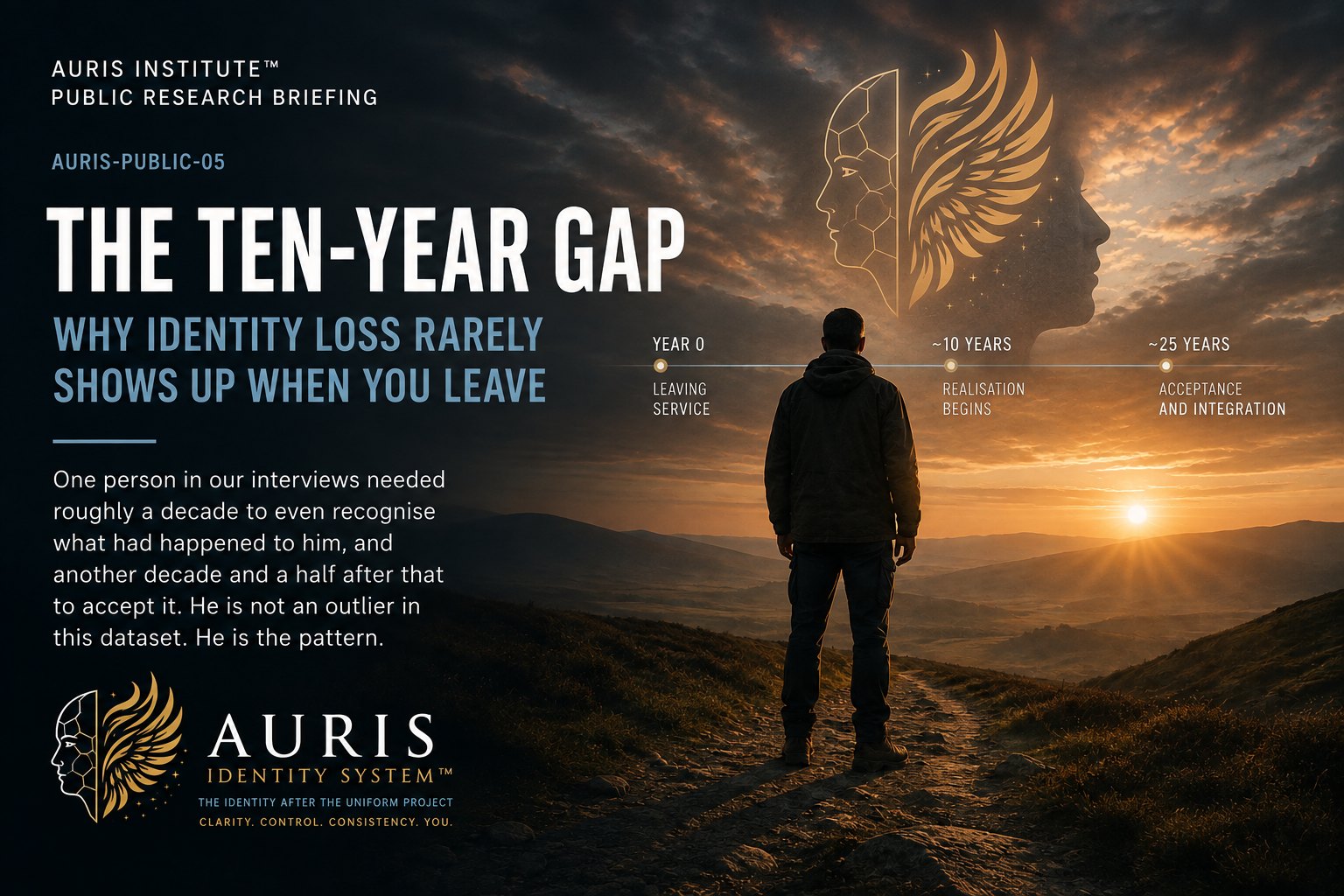
The Ten-Year Gap
One person in our interviews took roughly ten years to even notice what had happened to him. Then another fifteen to accept it. He isn't an outlier in this dataset. He is the pattern.
 Research note · July 2026
Why Identity, Not Employability, Is the Real Transition Crisis
86% of service leavers find a job within six months. Almost none of them are asked whether they know who they are without the uniform on.
 Research note · July 2026
Inside the Evidence: What We Know, What We Don't, and Why We're Still Testing
Most organisations publish their findings. Very few publish their gaps.
 Research note · July 2026
From Research to Practice: The Pilots and the Four Questions They're Answering
A pilot is not a proof point, it's a live test of a question we genuinely don't know the answer to yet.
 Essay · July 2026
Why This Matters Now: Policy, Partners and What Comes Next
In June 2026 we took this research to Parliament, before every question was answered, because evidence-first engagement matters more than waiting for certainty that may take years to arrive.
 Research note · April 2026
The family transitions too
Identity loss after service is rarely the veteran's alone, partners and families carry their own.
 Announcement · March 2026
The AURIS Identity System is open at aurisidentity.com
A quiet, private companion for the work, available now in the browser.