AURIS Is Evolving: Building What Comes Next
Identity After the Uniform | Edition 01
Understanding identity. Navigating change. Building what comes next.
Originally published on LinkedIn, 11 October 2026
There comes a point in life when the question is no longer simply, What do I do?
It becomes something much more personal.
Who am I now?
Sometimes that question follows a major event. Leaving the Armed Forces. Retiring from a career. Becoming a parent. Experiencing illness, loss or a significant change in circumstances.
Other times, there is no single defining moment.
Life continues. We keep showing up. We fulfil our responsibilities. From the outside, everything might appear perfectly normal.
Yet something feels different.
The role that once gave us structure has changed. The routines we relied upon no longer fit. The way we understand ourselves may no longer reflect the life we're living.
And often, nobody has taught us how to navigate that.
Identity is more than the role we hold
During my 15 years in the British Army, I experienced firsthand how much identity can become connected to our responsibilities, routines, relationships and sense of purpose.
Military service provides a particularly clear example, but this experience isn't exclusive to those who have worn a uniform.
We see similar questions emerge across emergency services, healthcare, family life, employment and major personal transitions.
What happens when something that has shaped your life changes?
What remains?
What needs to be understood?
And how do you begin building what comes next without feeling that everything before it has somehow been lost?
These questions became central to my work in identity performance psychology and the development of the AURIS Identity System™.
Why AURIS is evolving
AURIS began with a belief that still guides everything we're developing:
People deserve practical ways to understand themselves and navigate change, not simply advice about being resilient or moving forward.
But as the research, conversations and educational work have developed, something has become increasingly clear.
Understanding is important, but understanding alone isn't always enough.
Someone might recognise why they're struggling with a particular transition, yet still need help establishing a routine.
They might complete a course and understand their reactions more clearly, but need practical tools to apply that learning when life becomes difficult.
They might recognise that they need connection, but have no idea which organisations, groups or opportunities are available to them.
That is why we're working towards a more connected AURIS ecosystem.
Not simply more courses.
Not another app for the sake of having an app.
But a system where education, practical application and access to support work together.
Five connected steps
The direction we're building follows five simple experiences.
Discover. Find reliable information, resources, organisations and opportunities relevant to your circumstances.
Understand. Explore identity, behaviour, change and the factors influencing how we experience life.
Learn. Develop knowledge and practical skills through structured education and reflection.
Practise. Apply that learning through the AURIS Identity System, personal reflection and digital coaching tools.
Connect. Find people, communities and services that can support your next steps.
And importantly, the journey doesn't have to begin at the same place for everyone.
Some people need information.
Others need structured learning.
Some need space to reflect.
Others simply need to know that somewhere nearby, there is a group they can walk into and feel welcome.
The purpose is to make those next steps easier to find and understand.
Technology should simplify life, not complicate it
One of the most important principles guiding the next stage of AURIS is simplicity.
If someone is already learning through the AURIS Academy, they shouldn't need another account to access their learning through the mobile app.
If they complete an exercise, their progress should remain available wherever they return.
If they need to find community support, they shouldn't have to pay for a course before they can discover it.
And if technology isn't available, the entire experience shouldn't become inaccessible.
These might sound like straightforward expectations.
But anyone who has navigated multiple learning platforms, membership systems or support directories will recognise how quickly things can become fragmented.
We're trying to design around the person using the system, rather than expecting the person to navigate the complexity of the system.
There is still technical work, testing and independent verification ahead. I'm sharing the direction we're taking, not suggesting that every element has already been completed.
The research must remain at the centre
As AURIS develops, the research remains fundamental.
Through Identity After the Uniform, I've been listening to people describe their experiences of identity, transition, belonging, responsibility and change.
Some accounts are difficult to hear.
Others challenge assumptions about what transition is supposed to look like.
And many remind me that two people can experience a similar event but make sense of it in completely different ways.
That matters.
Because if we design support around assumptions rather than listening, we risk building something that looks impressive but doesn't meet the needs of the people it was intended to help.
Our responsibility is to keep questioning, testing and improving.
The AURIS framework is built around five pillars:
Awareness → Understanding → Regulation → Identity → Stability.
Those pillars provide a structure for our educational and practical work.
But the experiences people share, and the evidence we continue to gather, must inform how the system develops.
We must also be careful not to confuse promising feedback with proven outcomes. Building credibility means being transparent about what we've learned, what remains uncertain and what still needs independent evaluation.
What comes next?
The next stage is about bringing the existing AURIS Academy and mobile identity tools together, creating a simpler experience for learners.
Beyond that, our ambition is to develop the AURIS Connection Hub into a free, accessible way for people to discover relevant organisations, events, groups and opportunities.
The Institute website will remain the central home for our research, education and public information.
The aim is not to keep people inside AURIS.
It's to help them find what is useful, including support that exists beyond us.
Because success shouldn't be measured only by how many people visit a website, download an app or complete a course.
It should also be considered in terms of whether people can understand their circumstances, make informed choices and identify meaningful next steps.
Those are the outcomes we want to investigate and evaluate as the work develops.
A question I'd love you to consider
Think about a time in your life when something important changed.
Perhaps you left a job, finished a career, experienced a loss, became a parent or found yourself facing a future you hadn't anticipated.
What helped you feel like yourself again?
Was it understanding what had changed?
Finding a new routine?
Connecting with other people?
Learning something new?
Or simply having someone listen without trying to fix everything?
I'd genuinely love to hear your thoughts.
Because the next chapter of AURIS should continue to be informed by the people whose experiences make this work necessary.
Thank you for being part of the conversation.
Gemma Gardner Founder, AURIS Identity System™ Independent Researcher | Identity Performance Psychology™
Clarity. Control. Consistency. You.
Explore AURIS: https://aurisidentity.org
About this newsletter: Identity After the Uniform explores identity, transition and the human experience of change through research, lived experience and practical understanding. Although the research began with experiences connected to uniformed service, the conversations extend far beyond it.
More from Insights and Updates
 Essay · 24 October 2026
Leaving the role. Finding where you belong.
Early community questionnaire figures with Trafford Veterans CIC point to connection, face-to-face conversation and knowing where to start as pressing concerns after leaving a role.
 Research note · August 2026
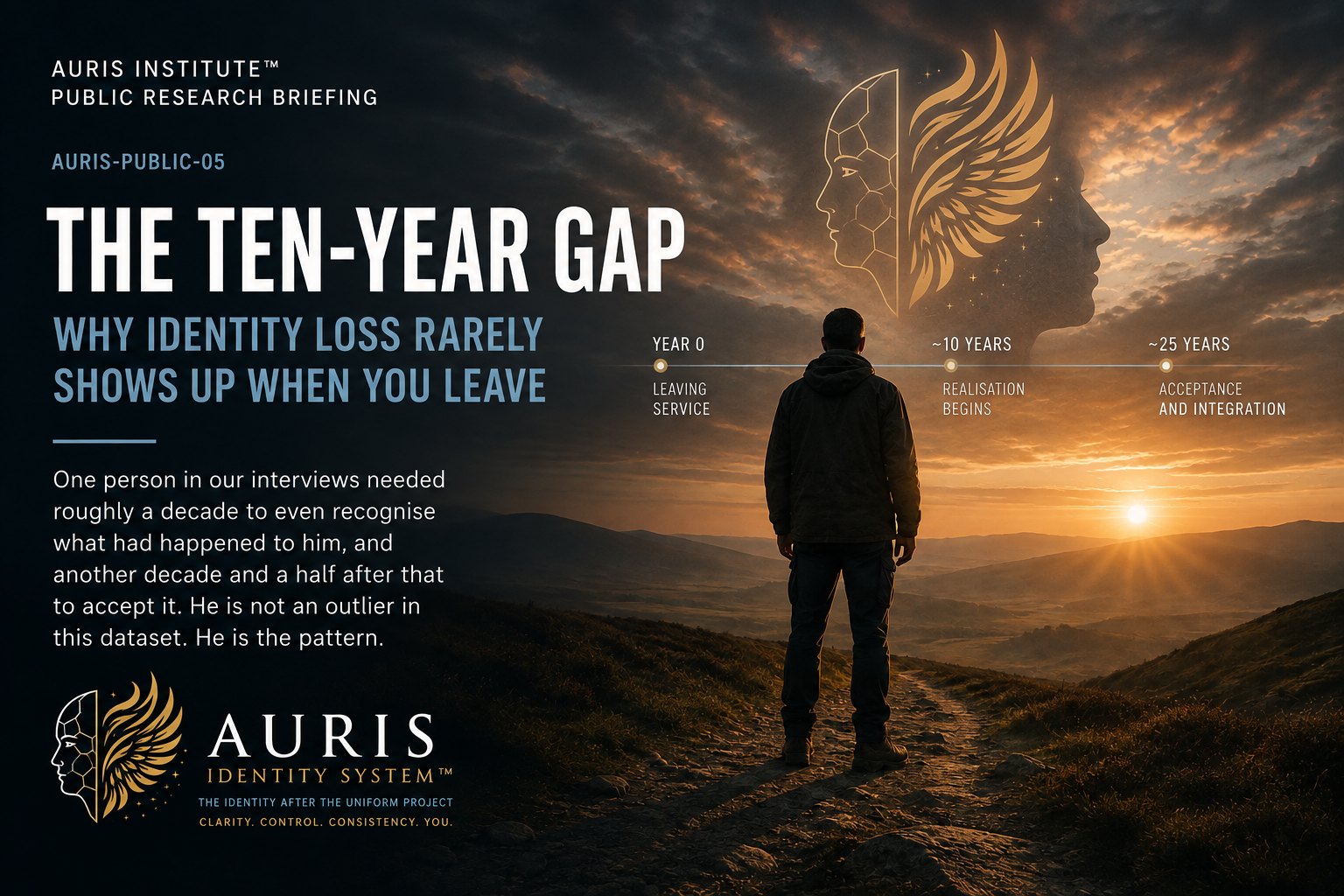
The Ten-Year Gap
One person in our interviews took roughly ten years to even notice what had happened to him. Then another fifteen to accept it. He isn't an outlier in this dataset. He is the pattern.
 Research note · July 2026
Why Identity, Not Employability, Is the Real Transition Crisis
86% of service leavers find a job within six months. Almost none of them are asked whether they know who they are without the uniform on.
 Research note · July 2026
Inside the Evidence: What We Know, What We Don't, and Why We're Still Testing
Most organisations publish their findings. Very few publish their gaps.
 Research note · July 2026
From Research to Practice: The Pilots and the Four Questions They're Answering
A pilot is not a proof point, it's a live test of a question we genuinely don't know the answer to yet.
 Essay · July 2026
Why This Matters Now: Policy, Partners and What Comes Next
In June 2026 we took this research to Parliament, before every question was answered, because evidence-first engagement matters more than waiting for certainty that may take years to arrive.
 Essay · May 2026
When the uniform comes off
Why identity, not employment, is the deepest challenge of military transition.
 Research note · April 2026
The family transitions too
Identity loss after service is rarely the veteran's alone, partners and families carry their own.
 Announcement · March 2026
The AURIS Identity System is open at aurisidentity.com
A quiet, private companion for the work, available now in the browser.