
Leaving the role. Finding where you belong.
Identity After the Uniform | Edition 02
Identity After the Uniform | Edition 02
Of 65 reviewed questionnaire responses identifying as veteran or former serving personnel, 33 selected groups, activities or friendships among their top three priorities for help.
48 selected face-to-face conversation as a way they would choose to find support.
31 said not knowing where to start made finding or asking for help difficult.
These are early figures from the community questionnaire I am working on with Trafford Veterans CIC.
They deserve attention.
Behind every response is someone with their own experience of service and life beyond it. Some are finding their way comfortably. Others are describing difficulties accessing support, finding connection or knowing where they fit.
For anyone who has left a role that shaped their days, the question may feel familiar:
Where do I belong now?
What we are hearing
Over the past two weeks, connection has become a pressing concern in the work I am doing alongside Trafford Veterans CIC.
The questionnaire register reviewed for this edition contains 84 online responses approved for analysis, including 65 selecting veteran or former serving personnel.
Among those 65 veteran responses:
- 33 selected groups, activities or friendships among their top three help priorities.
- 48 selected face-to-face conversation as a preferred way to find help.
- 31 selected not knowing where to start as a barrier.
- 27 described finding the support or activities they wanted as fairly or very difficult.
Some written responses describe social isolation directly. They include difficulties with transport, limited local connections and having nobody close to talk to.
That concerns me deeply.
The figures do not tell us that 33 respondents are lonely. Wanting help finding friendships or activities is not the same as reporting isolation. But alongside those written accounts, they give us a clear reason to examine connection more closely.
These are preliminary consultation responses, not a representative survey of veterans. Respondents could select several options, and checks for duplicate responses remain part of the review.
We should take what people are telling us seriously while being precise about what it shows.
Would anyone notice if you stopped turning up?
Leaving a role can change the ordinary contact we barely noticed while we had it.
The people you saw every morning. The familiar conversation. The shared humour. The knowledge that someone expected you to be there.
During my 15 years in the British Army, structure, responsibilities and shared expectations were part of everyday life.
Leaving an environment like that can change much more than your working hours.
You may miss being understood without having to explain yourself. You may miss knowing how your contribution fits. You may have people around you and still struggle to find the kind of connection you once took for granted.
For some people, those changes bring welcome freedom. For others, they are difficult. Both experiences deserve space.
Having somewhere to live and something to do does not tell us everything about whether someone feels they belong.
Who do they speak to during an ordinary week?
Where can they contribute?
Who notices when they withdraw?
Those questions deserve a place in how we understand transition.
Finding information is only the beginning
Across all 84 reviewed responses:
39 selected not knowing where to start.
37 selected uncertainty about whether they were eligible.
20 selected no reply or no follow-up.
Those barriers matter because asking for help already requires someone to take a step.
They may have spent time deciding whether their difficulty was worth mentioning. They may be unsure how to explain what they need.
If the next step is confusing, eligibility is unclear or nobody replies, that effort may lead nowhere.
A useful question for any organisation is:
What happens after someone first reaches out?
Can they understand whether the service is for them? Do they know what to expect? Can they speak to someone? Does anyone follow up?
The preference for face-to-face conversation also deserves attention. It tells us to preserve human routes into support as we consider how a connection hub could help people find their way.
What happens to identity when the role changes?
This reaches beyond military service.
A nurse retires. An employee leaves a career built over decades. A parent’s children become independent. A caring responsibility ends. Illness changes what someone can do.
The circumstances differ, but each can raise questions about usefulness, belonging and self-worth.
If you have spent years being the person others depend on, receiving help yourself may feel unfamiliar.
If your days have been organised around responsibility, a quieter day may be difficult to value.
If people have known you through your position, introducing yourself without it may feel exposing.
A role can give us opportunities to express important parts of ourselves: care, judgement, humour, creativity, commitment or courage.
When that role changes, those qualities may still matter deeply. Finding ways to express them in different circumstances can take time.
You may need new opportunities to contribute, connect and recognise your own value.
We need room for different experiences
We must also pay attention to people whose experiences challenge the story we expect.
Across the reviewed community responses, some people described finding support as easy. Some already use and value existing provision.
That matters.
Understanding what works is as necessary as identifying what is missing.
Equally, we should avoid assuming that every veteran feels isolated, every career change creates an identity crisis or every person wants to rebuild the life they had before.
Knowing which role someone has left tells us very little about what it meant to them.
We need to ask.
From awareness to stability
The AURIS Identity System uses five connected pillars:
Awareness → Understanding → Regulation → Identity → Stability
They offer a structure for reflection when circumstances change.
Awareness: What has changed in my everyday life? What am I noticing about myself?
Understanding: What did that role give me in terms of connection, responsibility, structure or meaning?
Regulation: What helps me respond when uncertainty or pressure becomes difficult?
Identity: Which qualities and values matter to me now? Which expectations do I want to reconsider?
Stability: What routines, relationships and practical steps could help my present life work better?
These questions can help make a broad concern more specific.
“I feel disconnected” might become “I miss having people to speak to during the week.”
“I don’t know who I am anymore” might become “I haven’t found somewhere to use the qualities I value in myself.”
That gives us something to explore and act on.
One reflection for this week
Think of a role that has shaped you.
What did it allow you to express about yourself?
Perhaps you solved problems, supported others, brought people together or stayed dependable when circumstances were difficult.
Then ask:
Where could I express one of those qualities this week, and who could I connect with through doing it?
Keep the answer small enough to try.
You do not need to decide the rest of your life before taking one meaningful step.
Help us understand more
I am sharing two separate questionnaires with different purposes.
Identity After the Uniform research
My research explores experiences of identity, belonging, purpose and adjustment across service-related lives and changing roles.
The written questionnaire welcomes eligible adults from the Armed Forces, reservist and first-response communities, including adult family members.
It takes approximately 25–40 minutes. Research questions are optional, participation is voluntary and responses are handled confidentially.
Positive experiences, difficult experiences and experiences of little change are all valuable.
Take part in Identity After the Uniform research
Trafford Veterans CIC community questionnaire
This shorter questionnaire asks about finding support, activities and connection, the barriers people encounter and what would make a connection hub useful and trustworthy.
The figures in this newsletter come from this community questionnaire, not from the Identity After the Uniform written research questionnaire.
We are particularly keen to hear from serving personnel, reservists and those preparing to leave, alongside eligible veterans and military family members.
Complete the Trafford Veterans CIC community questionnaire
Please read the participation information for each. Taking part is your choice, and you do not need to complete both.
Sharing the relevant invitation privately with someone eligible can also help us hear perspectives we might otherwise miss.
Join the conversation
What helped you feel that you belonged after a significant role in your life changed?
You are welcome to share a general reflection in the comments. Please keep sensitive personal experiences and identifying details private.
Leaving a role can change where we feel recognised, understood and useful.
We need to make those parts of transition easier to talk about, and easier to find support for.
Gemma Gardner
Founder, AURIS Identity System
Independent Researcher | Identity Performance Psychology
Clarity. Control. Consistency. You.
https://aurisidentity.org
Figures are from the Trafford Veterans CIC community questionnaire register reviewed for this edition, covering online responses received from 16–23 October 2026. Known test submissions were excluded. These are response counts, not confirmed unique-person totals; duplicate checks remain necessary. Multiple selections were permitted.
This newsletter is educational and reflective. It does not replace individual clinical or psychological support.
More from Insights and Updates
 Announcement · 11 October 2026
AURIS Is Evolving: Building What Comes Next
Why AURIS is working towards a more connected system where education, practical application and access to support work together, with the research kept at the centre.
 Research note · August 2026
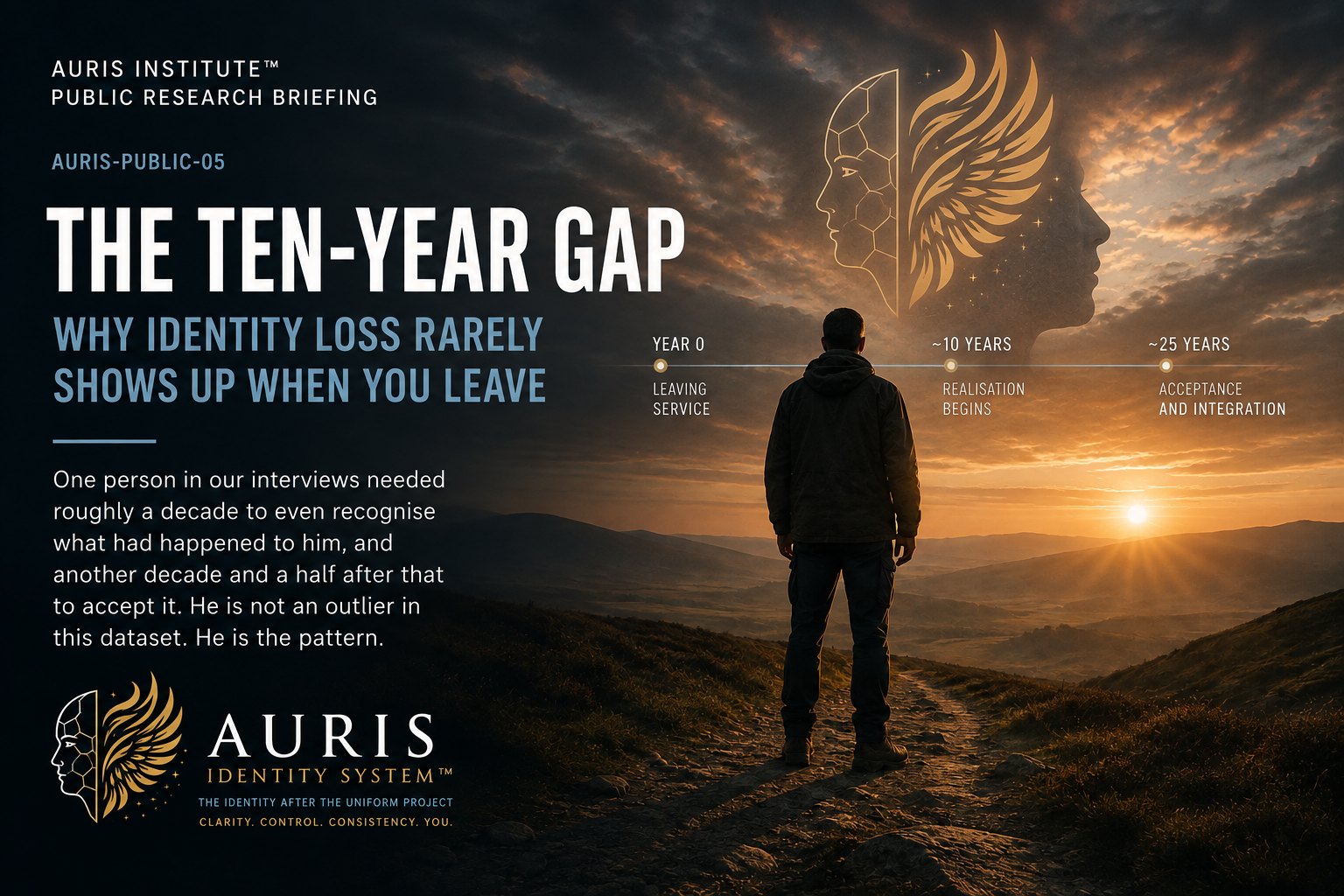
The Ten-Year Gap
One person in our interviews took roughly ten years to even notice what had happened to him. Then another fifteen to accept it. He isn't an outlier in this dataset. He is the pattern.
 Research note · July 2026
Why Identity, Not Employability, Is the Real Transition Crisis
86% of service leavers find a job within six months. Almost none of them are asked whether they know who they are without the uniform on.
 Research note · July 2026
Inside the Evidence: What We Know, What We Don't, and Why We're Still Testing
Most organisations publish their findings. Very few publish their gaps.
 Research note · July 2026
From Research to Practice: The Pilots and the Four Questions They're Answering
A pilot is not a proof point, it's a live test of a question we genuinely don't know the answer to yet.
 Essay · July 2026
Why This Matters Now: Policy, Partners and What Comes Next
In June 2026 we took this research to Parliament, before every question was answered, because evidence-first engagement matters more than waiting for certainty that may take years to arrive.
 Essay · May 2026
When the uniform comes off
Why identity, not employment, is the deepest challenge of military transition.
 Research note · April 2026
The family transitions too
Identity loss after service is rarely the veteran's alone, partners and families carry their own.
 Announcement · March 2026
The AURIS Identity System is open at aurisidentity.com
A quiet, private companion for the work, available now in the browser.