
The Family's Transition
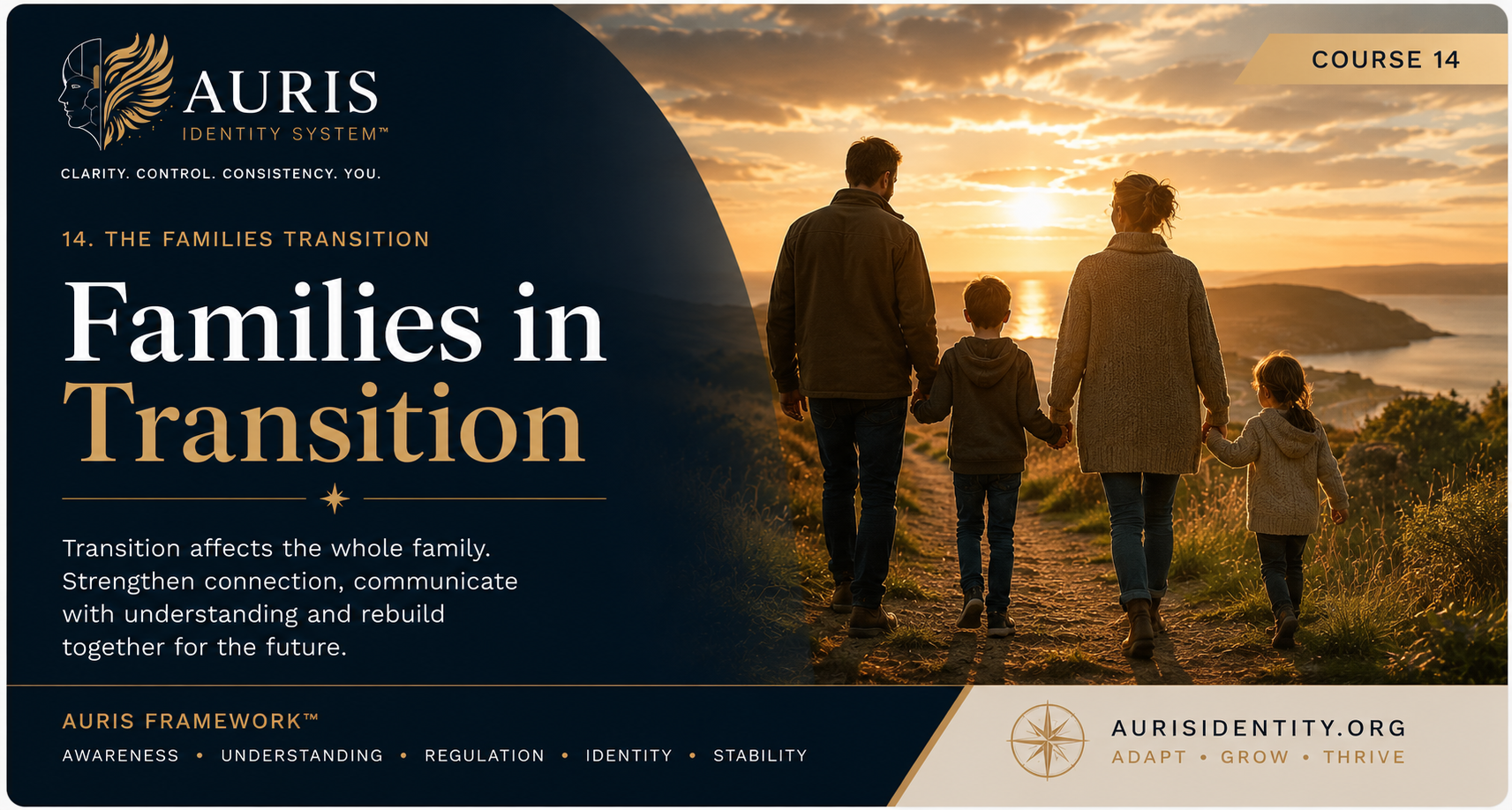
Transition belongs to everyone at home.
By the end you will be able to talk about the change at home in a way the whole household can take part in.
Part of the AURIS approach to identity, stability and human development.
- Applied
- £10.00
- Certificate on completion
A practical guide for families navigating one of life’s biggest changes together.
£10.00 one-off payment, lifetime access
- 1. Sign in, or create a free account. It takes a name, an email address and a password.
- 2. Pay by card on the course page. The payment form is Stripe's own, so AURIS never sees or stores your card details.
- 3. The course opens straight away and stays in your library. There is no subscription and nothing renews.
A certificate is issued when you finish every lesson and pass the assessment.
Who this course is for
“I do not know how to explain this change to the children.”
Children usually notice a change before anyone explains it. Talking about it plainly and building a shared family story is practical work, not a conversation you have to get perfect.
Where this course fits
- Where it sits
- Specialist learning inside the Family and Belonging pathway.
- What usually comes before
- Most people take Belonging After Service before this one, though nothing here requires it.
- What usually comes next
- Emotional Regulation is next in the Family and Belonging pathway. Steadies the reactions that change tends to provoke.
This course can be taken together with other qualifying AURIS short courses as one bundle, priced by how many you choose. See how bundles work.
A pathway is a suggested order, not a requirement. Nothing here has to be bought to make this course work.
The pathways it belongs to
- Part of the Family and Belonging pathway: Everyone asks how he is. Who asks how you are?
A pathway is a suggested order, not a requirement. This course can be taken on its own.
About this course
A short course on transition as something a whole family goes through together, practical routines, talking with children about change, and building a shared family story that holds through it. Evidence note (corrected against the AURIS Academy Strategic Blueprint's current research record): AURIS's interview research includes spouses and partners in depth, and also includes a fully-logged interview with an adult who grew up as a military child (EP002, Andy Hunsley, a nomadic British Army of the Rhine (BAOR) childhood, the inherited-instability pattern, and the moment his own son's remark became his turning point). That adult-retrospective account is real, direct evidence and should inform this course's framing of what growing up in a military family can carry forward. The gap that genuinely remains is narrower: no interviews with currently-living minors, which would need its own safeguarding and consent process distinct from the adult-consent process used elsewhere. The content on talking with children below is grounded in general, published child-development and family-transition literature for that reason, clearly separated from AURIS's own primary research, not because no relevant AURIS research exists at all.
What you will learn
- Understand transition as a family-system event, not only an individual one
- Approach conversations with children about change plainly and age-appropriately
- Rebuild family routines deliberately after an external structure disappears
- Build a shared family narrative that carries forward, not just an ending
Why this matters
Primary pillar: Stability. This course builds Stability by working on the household rather than only the individual, because steadiness at home is what holds when everything else moves.
Course curriculum
4 lessons. The lesson content itself opens once you start the course.
Lesson 1 · about 10 minutes
The Family Moves Too
This lesson is here so you can frame transition as a whole-family event and name what changed for each person in your family, not only the person who served.
- Frame transition as a whole-family event
- Identify what changed for each family member, not just the person who served
Lesson 2 · about 10 minutes
Talking to Children About What's Changing
This lesson is here so you can talk with your children about what is changing plainly, honestly and in language that fits their age.
- Approach conversations with children about family transition plainly, honestly, and age-appropriately
Lesson 3 · about 10 minutes
Rebuilding Family Routines After the Structure Goes
This lesson is here so you can apply the minimum week and structure-rebuilding principles from earlier AURIS courses at family level.
- Apply the "minimum week" and structure-rebuilding principles from earlier AURIS courses at the family level
Lesson 4 · about 10 minutes
The Family's New Story
This lesson is here so your family can build a shared, honest story that carries forward rather than stopping at an ending.
- Build a shared, honest family narrative that carries forward rather than only marking an ending
What is included
- Audio narration
- Guided reflections
- Interactive exercises
- Practical activities
- Assessment
- Portfolio work
- Certificate on completion
Research and evidence
Evidence note (corrected against the AURIS Academy Strategic Blueprint's current research record): AURIS's interview research includes spouses and partners in depth, and also includes a fully-logged interview with an adult who grew up as a military child (EP002, Andy Hunsley, a nomadic British Army of the Rhine (BAOR) childhood, the inherited-instability pattern, and the moment his own son's remark became his turning point). That adult-retrospective account is real, direct evidence and should inform this course's framing of what growing up in a military family can carry forward. The gap that genuinely remains is narrower: no interviews with currently-living minors, which would need its own safeguarding and consent process distinct from the adult-consent process used elsewhere. The content on talking with children below is grounded in general, published child-development and family-transition literature for that reason, clearly separated from AURIS's own primary research, not because no relevant AURIS research exists at all.
Common questions
- How much does The Family's Transition cost?
- It is £10 on its own, bought once and yours to keep. If it belongs to a pathway, the four paid courses on that pathway are £20 together, and the free course on that pathway stays free.
- Do I get a certificate?
- Yes. Finishing the course issues an AURIS Certificate of Completion in your name. It records your learning. It is not a qualification, accreditation or licence to practise, which is what the separate AURIS Practitioner Certification is for.
- How long does it take, and is it self-paced?
- It is self-paced. Once you enrol, every lesson is open, there is no deadline and nothing expires.
- Do I need to do anything before this course?
- No. You can start here. The courses are written to stand on their own, and a pathway is only a suggested order rather than a requirement.
Course progression
- Foundation
- Applied
- Practitioner
Related courses
Previous course
Leading After the Rank
Course detailsNext course
Staying Switched On
Course detailsBundle
Build your own short course bundle
See the bundle
The evidence behind this course
Evidence
AURIS interview EP002 (Andy Hunsley) — AURIS
A logged, adult-retrospective interview describing a nomadic British Army of the Rhine (BAOR) childhood and an inherited-instability pattern that surfaced later in the interviewee's own life.
How AURIS interprets it
- AURIS treats this single adult-retrospective account as real, direct evidence about what growing up in a military family can carry forward, while being clear it is one interview, not a study of children.
- AURIS is explicit that it holds no interviews with currently-living minors, so the course's content on talking with children is drawn from general published child-development and family-transition literature, not from AURIS's own research, and the two are kept separate.
What you do with it
- You approach conversations with children about change plainly and age-appropriately, and rebuild family routines deliberately after an external structure disappears.
- You build a shared family narrative that carries the family forward rather than treating the change only as an ending.
Ready to begin?
£10.00 one-off payment, with lifetime access to the course.