
Research & Evidence | Identity After the Uniform
The World Can Tell You Who Qualifies as a Veteran. But Can It Tell You Who You Are Afterwards?
Forty seven conversations, different countries and one question that is becoming impossible to ignore.
· Gemma Gardner
Co-founder, AURIS Identity
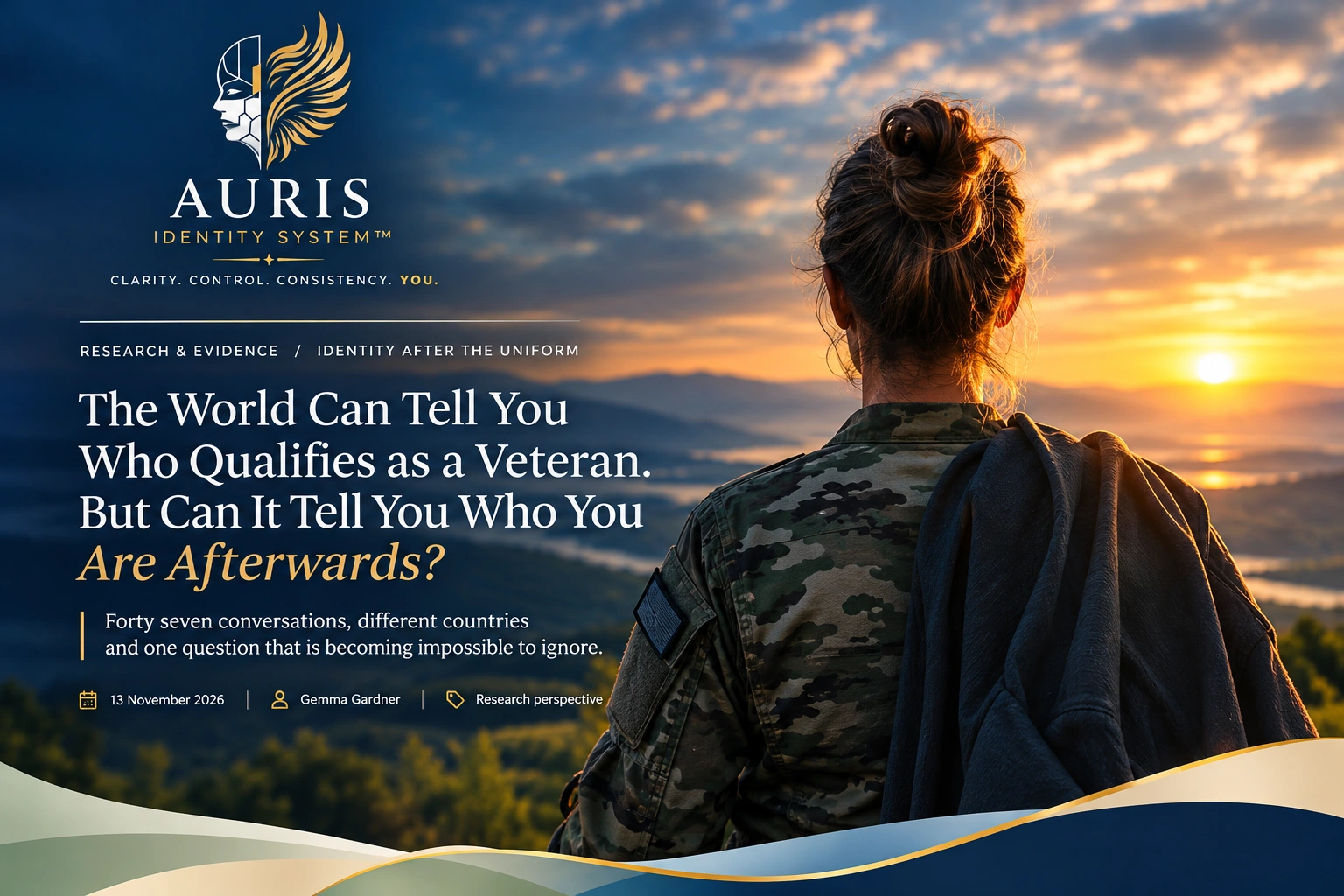
There is a moment in military life that almost everyone can picture, even if they have never experienced it themselves.
The moment somebody takes off their uniform for the last time.
Perhaps there is a parade. Perhaps there are photographs, handshakes and promises to stay in touch. Perhaps there is no ceremony at all. Just a final journey home, a bag placed beside the door and the knowledge that tomorrow will be different.
The paperwork will record when their service ended. Their discharge documents will confirm their status. Somewhere, a government system will record that another person has left the Armed Forces.
But none of those records can tell us what happens when that person wakes up the following morning.
Whether they feel relieved or frightened. Whether they miss the people, the structure or the responsibility. Whether they are excited about what comes next, or whether they have spent so long knowing exactly where they belong that they have forgotten how to imagine belonging anywhere else.
And there are people who wake up the next morning feeling something entirely different.
Freedom.
They are ready to leave. They have plans, relationships and ambitions that have little to do with their former career. They may be grateful for their service without wanting it to define the rest of their lives.
Both experiences are real.
Yet when we talk about military transition, we so often speak as though everyone is travelling along the same road.
That was one of the questions that made me begin Identity After the Uniform.
And the more people I speak to, the more I realise how much we still need to understand.
Forty seven people have helped bring us this far
When I started this research, I had my own experiences to draw upon. I knew what it felt like to build a life around military service and then have to find my way into a different one.
But I also knew something important.
My story could explain my experience. It could not explain everybody else's.
So I began asking people to talk to me.
Not simply about where they served or what they achieved, but about what their lives had become. About the things that had helped them. The things that had surprised them. The relationships that had changed and the parts of themselves that had remained.
Some conversations were difficult. Others were filled with humour, achievement and pride. Some challenged the very assumptions that had led me to begin the research.
And that is what made them valuable.
We have now reached 47 recorded conversations, with questionnaire contributions adding further perspectives.
I want everyone who has participated to understand what that means.
You did not simply help me collect stories.
You helped me recognise that the questions themselves needed to become bigger.
Because the more I listened, the more I began to wonder whether the way we recognise people after service, the way we support them and the way we measure their progress are always asking the same questions that matter to the people living through it.
And then another question emerged.
Who actually gets to call themselves a veteran?
Imagine serving your country and discovering that the answer depends on where you live
In the United Kingdom, a person is generally recognised as a veteran after just one day of service in the Regular or Reserve Armed Forces.
One day.
They do not need to have deployed to a conflict. They do not need to have completed a twenty year career. Their service is recognised under the government's definition.
Now imagine somebody in Canada.
Veterans Affairs Canada uses a definition that includes former Canadian Armed Forces members who successfully completed basic training and were honourably released.
Move to the United States and the legal position changes again. Federal veteran status generally depends on qualifying active service and discharge conditions, with additional rules affecting reservists and National Guard personnel.
In New Zealand, statutory recognition for veterans' support is tied to qualifying service, with particular rules around operational service and historical service periods.
Australia has its own distinctions between former serving personnel, veteran recognition and eligibility for particular services.
The same word travels across borders.
Its meaning does not always travel with it.
And behind those definitions are real people.
Someone who served briefly and left because of an injury. Someone who completed decades of service without ever deploying overseas. Someone whose Reserve service shaped their entire adult life. Someone who served in a dangerous environment but whose circumstances do not fit neatly within a particular eligibility rule.
A government must establish definitions. Services need criteria, budgets and ways of deciding who qualifies.
But there is a difference between deciding who is eligible for support and understanding what service has meant to somebody's life.
There is another difference that troubles me just as much.
Some people qualify as veterans but do not feel comfortable calling themselves one.
Perhaps they believe they did not serve long enough. Perhaps they associate the word with combat or with an older generation. Perhaps they simply do not want their former role to become the description by which everyone knows them.
Others carry that identity proudly for the rest of their lives.
Neither response should be dismissed.
Because being recognised as a veteran and identifying as a veteran are not necessarily the same experience.
If we fail to understand that distinction, how can we be certain that the people who need support will recognise themselves in the services designed for them?
Governments are doing more. That makes the next questions even more important.
There are millions of people whose lives are connected to military service.
The 2021 Census recorded approximately 1.85 million veterans living in England and Wales.
Australia's 2021 Census identified 496,276 former serving Defence Force members, alongside those still serving.
Behind those figures are families, communities and generations of experience.
Governments are responding to significant challenges. Employment support, healthcare, resettlement, family services and community programmes continue to develop.
Australia's Royal Commission into Defence and Veteran Suicide delivered 122 recommendations in 2024. The scale of that work reflects the seriousness of the issues being examined and the importance of listening to those affected.
I do not look at that work and see a lack of effort.
I see governments, researchers, charities, veterans' organisations and families trying to address problems that have consequences far beyond the day somebody leaves service.
And I see an opportunity to ask what else we need to understand.
Because finding someone a job matters enormously.
So does making sure they can access healthcare, housing, financial advice and the practical support they need.
But what happens when somebody has achieved all of those things and still feels that something important is missing?
What happens when a person appears to have transitioned successfully on paper, but does not feel settled in their own life?
And equally, what can we learn from somebody who leaves service, builds a fulfilling future and never experiences the identity difficulties we might have expected?
We should be just as interested in understanding what went right.
A successful transition should never be defined solely by what somebody has obtained. We also need to understand what their life has become.
That does not mean existing programmes are ineffective. It means that if we want to understand their lasting impact, we need to look beyond the outcomes that are easiest to count.
The answers did not begin with AURIS
This is something I feel strongly about.
Long before I began these conversations, researchers were examining identity, belonging, psychological adjustment, social relationships, life transitions and the ways people make sense of change.
Their work matters.
It gives us theories to question, evidence to compare and decades of learning that should not be overlooked simply because we are asking questions in a new setting.
My own AURIS framework explores Awareness, Understanding, Regulation, Identity and Stability.
I believe those areas are important. They helped me begin to organise the questions I wanted to explore.
But belief is not evidence.
And building something that appears useful is not the same as demonstrating that it works.
If we want this research to make a meaningful contribution, we have to be prepared to discover things we did not expect.
We must be willing to recognise when existing approaches already provide the answers. We must listen to experiences that contradict our thinking. And we must be able to explain not only what people experience, but why those experiences differ and what the evidence can reasonably support.
That is why the research cannot end with a collection of powerful interviews.
The interviews are where some of the most important questions begin.
Why I am bringing people together from around the world
As the conversations developed, another reality became increasingly clear.
Identity does not exist independently of culture, community or the society in which somebody lives.
What it means to belong can differ between countries, generations and communities.
The importance attached to military service can differ. So can the expectations placed upon somebody when they return home, the opportunities available to them and the support they are willing or able to seek.
Even the language we use to describe identity may not mean precisely the same thing everywhere.
How could one person, working from one country and one set of experiences, possibly claim to understand all of that?
I cannot.
And I would not want to pretend otherwise.
That is why we are developing the Global Identity Steering Group.
We are bringing together people who can examine this work through different disciplines, cultures, professional backgrounds and lived experiences.
People who understand military transition. People who study identity and belonging. People who understand psychological adjustment, research methodology, social systems and the influence of culture.
And importantly, people who are prepared to disagree.
I do not want a group assembled to tell me that my ideas are right.
I want people who will ask whether we have overlooked something. Whether our questions are fair. Whether the evidence supports what we think it does. Whether an explanation that makes sense in Britain would still make sense in Canada, Australia, New Zealand or somewhere entirely different.
I want us to be able to examine the research that has already been done and understand where our work might genuinely add something.
Because if we are asking people to trust us with their experiences, we owe them more than an attractive theory.
We owe them a serious attempt to understand.
What I want the people who have contributed to know
There is a reason I have written this article today.
It is not to announce that we have found the answer.
We have not.
It is not to suggest that 47 conversations represent every veteran, every country or every experience of leaving service.
They cannot.
I have written it because I want the people who have spoken to me to understand what their contribution is making possible.
When you agreed to share your experience, you may not have imagined that your conversation would become part of questions about international definitions, cultural differences, research methods and how governments understand transition.
You may simply have wanted somebody to hear what happened to you.
But those experiences have helped us see where we need to look more closely.
They have reminded us that people do not all leave service carrying the same feelings, the same opportunities or the same understanding of who they are.
They have challenged the temptation to treat transition as a single event, or to assume that the absence of an obvious difficulty means there is nothing more to understand.
And they have made it possible for us to take the next steps with greater care.
There is something deeply moving about that.
People who may never meet one another, living in different places and carrying entirely different experiences, are contributing to a shared attempt to understand something that affects human lives.
Not everyone will agree. Not every experience will point towards the same conclusion.
That is exactly as it should be.
To everyone who has taken part, thank you.
To the researchers whose work gives us a foundation, thank you.
To the people helping us challenge our thinking and develop this international conversation, thank you.
And to those who have yet to share their experiences, I hope you will see that there is room here for your perspective too.
Not because it must fit a particular theory.
But because it might help us see something we have not yet understood.
A final thought
A government can define who is a veteran.
It can establish eligibility, record service, fund programmes and measure how many people receive support.
Those things matter.
But a definition cannot tell us whether somebody feels proud of their past, uncertain about their future, relieved to have left or unable to imagine themselves without the role they once held.
It cannot tell us what belonging feels like to them.
It cannot tell us whether the life they are building is one they recognise as their own.
For that, we have to listen.
We have to examine what people tell us alongside the research that already exists. We have to question our assumptions and be willing to change them.
And we have to remember that the purpose of this work is not to prove that everybody struggles when they leave service.
It is to understand why their experiences are different, what influences those differences and what might help people build lives that feel meaningful to them.
Forty seven people have already helped us begin that work.
I hope that one day, when we look back at what this research has achieved, those people will know that their willingness to speak helped us ask questions that might otherwise have remained unasked.
Because taking off a uniform tells the world that one chapter of a person's life has ended.
It does not tell us who they are becoming.
And that is the part of the story I believe we need to understand.
Gemma Gardner Co-founder, AURIS Identity Identity After the Uniform Research Project
Sources and further reading
Office for National Statistics: UK Armed Forces Veterans, Census 2021
UK Government: 10 Things to Know About Veterans and Their Families
US Code, Title 38, Section 101
Australian Bureau of Statistics: Service with the Australian Defence Force, Census 2021
Royal Commission into Defence and Veteran Suicide: Final Report
Veterans Affairs Canada: Veteran recognition and eligibility guidance