Why we built the Connection Hub, and what it actually does
A verified, worldwide directory of support organisations, events and opportunities, built into the AURIS Identity System because the research kept showing the same problem: the right support usually exists, it is just hard to find.
Sign in to save this read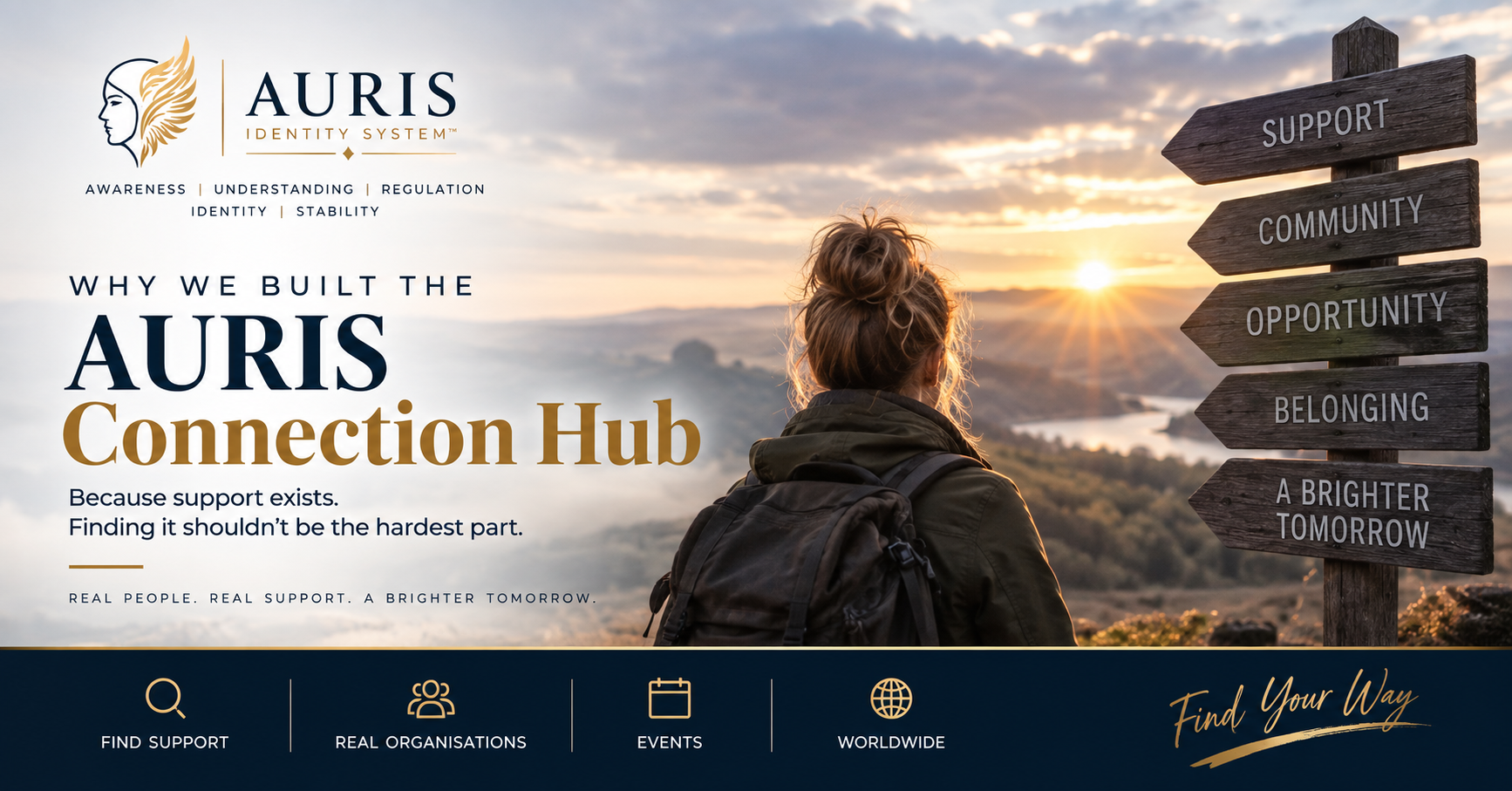
Executive summary
Across the Identity After the Uniform interviews, one pattern repeats regardless of service or sector: the support that helped someone usually existed already. Finding it was the hard part. The Connection Hub is AURIS's answer to that specific problem, a curated, worldwide directory of verified organisations, events and opportunities. Every listing is independently researched and verified by an AURIS administrator before it goes live. There is no self service listing, no reviews, and paid placement can never affect ranking or recommendations.
What the research kept showing us
Every episode of Identity After the Uniform eventually arrives at the same question. Not what happened to you, but who helped you find your way back.
The answers are never simple. A phone call that happened to land at the right moment. A named person at a named charity who picked up when nobody else did. A support group that existed but took years to find. Across the 38 of 108 interviews coded so far, out of a planned 108, a pattern keeps repeating: the support usually did exist somewhere. Finding it was the hard part.
Two founders of a veterans' charity in our dataset put it plainly: organisations cannot help someone they cannot find, and a person with no fixed address concludes that no one is looking for them either. Their entire organisation grew out of solving that one structural problem.
Our very first interview, with a military spouse who left service life in 1987, made a related point that has stayed central to AURIS ever since: she received no resettlement support at all, and the system was not built to see her. Nearly forty years later, that is still the most common shape of the problem. Not a lack of good organisations. A lack of a reliable way to find them.
Where our research has shown lasting stability, it tends to follow a sequence: rebuilding identity, reconnecting with a community, and finding a purpose that gives that identity somewhere to go. Community is not a soft addition to that sequence, it is the load bearing middle step. You cannot reconnect with a community you cannot find.
What the Connection Hub actually is
The Connection Hub is a curated, worldwide directory of verified support organisations, events and opportunities, built into the AURIS Identity System.
It is not an open marketplace, and organisations cannot list themselves. Every listing starts the same way: an organisation is identified, either through their own outreach or ours, and an AURIS administrator independently researches and verifies it before anything goes live. That means confirming the organisation genuinely exists, checking what it actually offers, verifying contact details are real, and completing a documented verification checklist with a named reviewer and a dated source.
Once verified, a listing shows real, useful detail: what the organisation does, who it is for, how to reach it, and any confirmed events, whether that is a weekly peer support group or an annual memorial day. Locations are handled properly from the start, worldwide, not just the UK.
- No self service listing and no organisation logins with publishing rights
- No reviews, no ranking that can be bought, paid placement never affects recommendations
- Contact always routes through the organisation's own verified details, AURIS never presents itself as the organisation
- Closed opportunities and past events leave public results automatically, records are archived, never deleted
Why curation, specifically
The instinct behind most support directories is to let anyone add themselves and let the crowd sort out quality later. We built the opposite of that, deliberately.
The people the Connection Hub is for are often reaching out at a genuinely vulnerable moment. A directory that includes anything and everything just recreates the same problem the research keeps surfacing, too much noise, no way to tell what is trustworthy, and no confidence the details are still accurate. Curation is slower to build. It is also the only version of this that someone in a hard moment can actually trust.
Where it sits inside AURIS
The Connection Hub connects to Find My Way, the guided tool that helps someone work out what they actually need. Its recommendations sit alongside AURIS courses and pathways as one more answer to the same question: what is actually available to you, right now, that can help.
It is being built in stages, deliberately, rather than launched all at once. Verified listings and events are live today. Fuller integration with Find My Way, and a layer that can answer plain language questions using only approved AURIS sources, are still being developed. That sequencing is not hidden. It reflects the same evidence discipline the research itself is held to: build what is verified, say only what is true about it, and be honest about what is still in progress.
The point of it
Identity After the Uniform was never only about understanding what identity loss looks like. It exists to shorten the distance between someone recognising they need help and actually finding it.
The Connection Hub is that idea made practical. Not a list. A verified way back to community, built from what the research actually told us people needed.
Frequently asked questions
Was this helpful?
Let us know so we can keep improving our research summaries.
Topics
- AURIS Connection Hub
- verified support directory
- veteran support directory
- identity after the uniform
- find my way AURIS
- community and belonging
- verified charity directory
Categories
Explore on this site
- → Explore the Connection HubBrowse verified support organisations and events.
- → Find My WayAnswer a few questions to see what is relevant to you.
- → Identity After the Uniform, emerging findingsThe research behind the Identity, Community, Purpose, Stability sequence.
Continue exploring related research
Further reading from the Knowledge Hub on the same themes.
- Foundations · 1 min readWhat is the AURIS Identity System?
AURIS is a five-pillar framework, Awareness, Understanding, Regulation, Identity, Stability, designed to support people through identity disruption and occupational transition.
- Research · 1 min readIdentity After the Uniform
An applied research strand focused on what happens to identity when a uniformed career ends, across military, police, fire and ambulance services.
- Research · 4 min readThe Identity Gap in Service Leaver Support: Why It Matters
Practical resettlement support is comprehensive, yet our review of UK transition guidance found very little explicit discussion of identity as a psychological process. This article explains what we examined, what we found, and where identity adaptation fits alongside existing support.
- White Papers · 2 min readWhite Paper 0, From Transition to Service Provider Identity Adaptation
A conceptual position paper reframing the Identity After the Uniform research programme: transition is the trigger, but the phenomenon under study is identity adaptation after a trained, high-pressure service role.
- Research · 6 min readI didn't start researching identity. I started trying to help people.
A first person account of how a medical discharge in 2014, a self funded CIC in 2015 and a woodworking project in Liverpool in 2017 turned into the questions now being asked through Identity After the Uniform.
Identity After the Uniform
Related research
Published records from the research programme behind this article.
- White Papers · 2 min readWhite Paper 0, From Transition to Service Provider Identity Adaptation
A conceptual position paper reframing the Identity After the Uniform research programme: transition is the trigger, but the phenomenon under study is identity adaptation after a trained, high-pressure service role.
- White Papers · 1 min readIdentity After the Uniform
Emerging findings from the first stage of the Identity After the Uniform research programme, a qualitative study of identity reconstruction after military service and other identity-defining roles.
- Research · 6 min readState of the Evidence: What We Know, What We Don't, and Why This Research Is Needed
An audit of the AURIS Master Evidence Repository, conducted 30 August 2026, setting out plainly which evidence is solid, which is located but not yet fully verified, which has been downgraded, and which gaps remain open.
- Research · 6 min readI didn't start researching identity. I started trying to help people.
A first person account of how a medical discharge in 2014, a self funded CIC in 2015 and a woodworking project in Liverpool in 2017 turned into the questions now being asked through Identity After the Uniform.
Gemma Gardner
Founder and Research Lead, AURIS Institute
Gemma Gardner leads the AURIS research programme on identity and occupational transition. Her work builds the evidence base behind the AURIS Identity System and the Identity System, drawing on interviews with service leavers, families and the organisations that support them.
- Lead author, Identity Performance Psychology white paper series
- Principal investigator, AURIS identity adaptation interview programme
- Author of AURIS submissions on identity in occupational transition
This sits closest to the After Service pathway.
Leaving the military: what happens to who you are?
Start free
Introduction to AURISDiscover how identity adapts and where rebuilding really begins.
The pathway for this situation
After ServiceFor service leavers and anyone leaving a long structured career. A free introduction, then four courses on delay, job churn, rank and rebuilding meaning.
No single course matches this reading closely enough to name one, so the specialist courses are listed on the pathway page instead.
Take this further in a course
Reading explains the pattern. A course gives you something to practise. Start with one free first lesson, about 12 minutes, no payment details, or choose the pathway closest to your situation.
Get new research by email
Occasional updates when we publish new Knowledge Hub research. No noise, and you can unsubscribe at any time.
Discussion
Read by a moderator before it appearsComments are for reflection and questions about the research. Please do not share anything about your health, another person, or your service record that you would not want read publicly.
No comments have been published on this article yet.
Join the discussion with a free AURIS account.
Sign in to commentWant to put this into practice?
Everything published here comes from the AURIS research programme. The AURIS Identity System, the separate membership platform at aurisidentity.com, is where the same framework is taught as guided courses and daily practice.
Join the AURIS Identity System at aurisidentity.comContinue learning
More from Foundations.