
The Silence Has Ended. But Their Stories Must Never Be Forgotten.
Identity After the Uniform | Edition 04
A Remembrance Sunday reflection on the fallen, bereaved families, veterans and serving personnel, and the care that continues after the ceremonies end.
Originally published on LinkedIn, 8 November 2026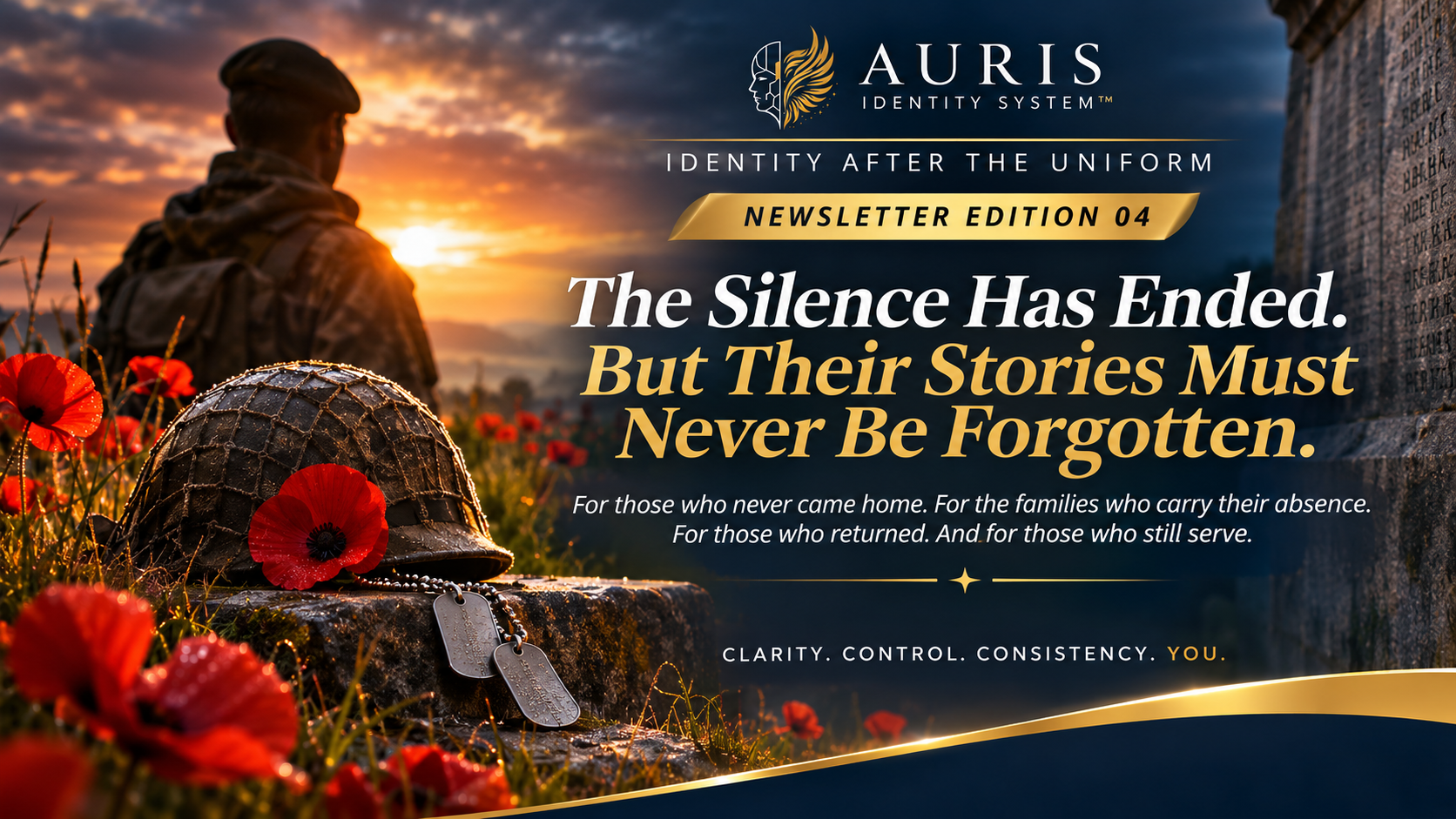
At eleven o'clock on Remembrance Sunday, 8 November 2026, people across the country stood in silence.
At war memorials, in churches, in town centres and in the quiet of their own homes, heads were lowered.
For two minutes, we remembered.
Then the silence ended.
The traffic began moving again. Conversations resumed. Families returned home. Children went back to playing. Life continued.
But somewhere, a mother was remembering the son who never came home.
A husband was thinking about the wife whose voice he would never hear again.
A daughter was looking at a photograph of a parent she never had the chance to know.
A veteran was remembering someone who once stood beside them, someone whose laughter they can still hear, even though years have passed.
And somewhere, a member of our Armed Forces was continuing their duties, away from home and the people they love.
For many of us, the silence lasted two minutes.
For others, the absence it represents has lasted a lifetime.
That is what I want us to remember today.
Not simply the uniforms.
Not simply the medals.
Not simply the names carved into stone.
But the people behind them.
The lives they lived.
The people they loved.
The futures they imagined.
And those who have spent years learning how to live with their absence.
Before they were names on a memorial, they were people
We speak of courage, sacrifice, duty and service.
And rightly so.
But sometimes, in our determination to honour those who died, we forget to speak about how they lived.
They were sons and daughters.
Husbands, wives and partners.
Mothers and fathers.
Brothers, sisters and friends.
They were the person who made everyone laugh when things were difficult.
The one who always remembered a birthday.
The friend who could be relied upon.
The parent who promised they would be home soon.
They had ordinary lives filled with extraordinary meaning to the people who knew them.
They had ambitions.
They made plans.
They imagined futures that would never come.
Some were barely adults when they died.
Others had already built families, careers and lives beyond their military responsibilities.
Every one of them had a story that began long before they put on a uniform.
And every one of those stories deserves to be remembered.
Because the true cost of losing a life cannot be measured only by the number of people who died. It must also be understood through the lives forever changed by their absence.
The families who carry the sacrifice
There is a part of military service that rarely appears in the photographs we see on Remembrance Sunday.
The family waiting at home.
The partner watching the calendar.
The parent hoping for news.
The child asking when Mum or Dad will be back.
For many military families, separation is a familiar part of life.
They learn to manage birthdays, school events, difficult decisions and everyday responsibilities while someone they love is away.
They celebrate homecomings.
They make the most of the time they have together.
And they understand that service often requires sacrifice from the entire family.
But for some, the homecoming never happens.
Instead, there is a knock at the door.
A conversation no family should ever have to experience.
And a future that changes in an instant.
What follows cannot be contained within a ceremony or a national moment of silence.
There are birthdays when someone is missing.
Christmas mornings that feel different.
Weddings where a photograph takes the place of a person.
Children growing older without the parent who should have been there to see it.
And ordinary days when grief arrives unexpectedly, perhaps through a familiar song, a smell or something someone says.
Some families find ways to speak openly about their loss.
Others hold their memories privately.
Some build remarkable lives while continuing to carry the absence of someone they love.
There is no single way to experience bereavement.
And there should never be an expectation that time makes a person less deserving of understanding.
For bereaved families, remembrance does not begin when the poppies appear. And it does not end when the wreaths have been laid.
Their loved ones mattered yesterday.
They matter today.
And their memory will matter long after the ceremonies have finished.
To those who returned, and those who remember
I spent fifteen years serving in the British Army.
When you serve alongside people, you come to know them in ways that can be difficult to explain.
You share responsibility.
You experience long days, difficult conditions, frustration, humour and moments that stay with you.
You learn who you can rely upon.
You recognise the familiar voices around you.
You develop friendships that are not always easy to recreate elsewhere.
And when someone is no longer there, their absence can remain part of the story of those who knew them.
For some veterans, today is about remembering friends who died.
For others, it is about reflecting on the people they served alongside, the experiences they shared and the years that shaped their lives.
Some will have attended parades this morning.
Some will have stood quietly at a local memorial.
Others will have chosen to remember at home.
And some may have decided that attending a public ceremony was not right for them.
All of those choices deserve respect.
We must never assume that remembrance looks the same for everyone.
Nor should we assume that every person who served carries the same experiences or feelings.
Many veterans look back on their service with pride, gratitude and lasting friendships.
Some carry difficult memories.
Others experience both.
Remembrance should make room for every one of those experiences without requiring anyone to explain or justify how they feel.
Sometimes the most meaningful act of remembrance is a conversation between old friends.
Sometimes it is visiting a grave.
Sometimes it is saying a name aloud.
And sometimes it is remembering someone quietly, without saying anything at all.
To those still serving
Today, as we honour those who gave their lives, we must also recognise those who continue to serve.
The soldiers, sailors and aviators fulfilling their responsibilities at home and overseas.
Those deployed away from their families.
Those preparing for operations.
Those supporting communities, maintaining readiness and carrying out work that many of us will never see.
And alongside them, the families whose lives are shaped by that service.
The partners managing home life during deployments.
The children missing a parent.
The parents and loved ones who understand that a telephone call can mean everything.
Military service is not simply part of our history.
It is part of our present.
And the people serving today are not defined only by their rank, regiment, ship, squadron or responsibilities.
They are individuals.
They have families, friendships, ambitions and futures they are working towards.
They deserve to be recognised as people, not simply as the uniform they wear.
We honour the fallen by remembering their sacrifice. We honour those still serving by recognising their humanity, their responsibilities and the families who stand beside them.
And that recognition must continue beyond today.
When the ceremonies end, our responsibility continues
Last Sunday, I published Edition 03 of Identity After the Uniform.
I asked a question that continues to stay with me.
We Remember Their Service. But Who Remembers Them Afterwards?
I wrote about veteran homelessness, mental health, funding and the challenges facing organisations trying to provide meaningful support.
I questioned whether we are always listening carefully enough to the people whose lives we say we want to improve.
Today, on Remembrance Sunday, that question carries a different weight.
Because remembering those who died should also encourage us to think about how we treat those who remain.
The bereaved family navigating life after loss.
The veteran adjusting to civilian life.
The serving person preparing for the future.
The partner who has carried responsibilities quietly for years.
The individual who appears to be doing well but has questions they have never felt comfortable asking.
And the many people who have built fulfilling lives after service and whose experiences deserve to be recognised too.
We should not assume that everyone needs the same support.
We should not assume that every veteran is struggling.
And we should not overlook the extraordinary contribution already being made by charities, communities, families and individuals.
But neither should we mistake public recognition for meaningful understanding.
Respect is something we demonstrate through our actions, not simply through the words we speak at a ceremony.
It is reflected in whether we listen.
Whether we take people's circumstances seriously.
Whether we recognise the difference between what someone appears to need and what they actually need.
And whether we remain willing to help when the public attention has moved elsewhere.
Behind every uniform is an identity that matters
Through my Identity After the Uniform research, I have been exploring how people experience service, transition, identity and belonging.
One of the questions at the centre of that work is what happens when a role that has shaped someone's life begins to change.
But today, I want to reflect on something even more fundamental.
No human being should ever be reduced to the role they performed.
A soldier is also someone's child.
A sailor may be a parent, a partner or a friend.
An aviator has a life, a personality and ambitions beyond their duties.
A veteran is not simply a former member of the Armed Forces.
And a bereaved family should never be defined only by the loss they have experienced.
Every person has a story that deserves to be understood in its own right.
That is something I believe we must carry into our conversations about remembrance, support and the future of our Armed Forces community.
Not everyone wants to talk about their experiences.
Not everyone wants to revisit the past.
Not everyone finds comfort in the same things.
But everyone deserves to be treated with dignity.
And sometimes, the most important thing we can do is listen without assuming we already understand.
The poppy represents more than a moment
Across the country today, people have worn poppies.
Some in memory of a relative.
Some in honour of friends.
Some to recognise generations of people who served and died in conflicts across the world.
For others, the poppy represents a deeply personal story they may never share.
It is a symbol that invites us to remember.
But remembrance is not something that belongs only to a symbol.
It belongs to the people whose lives were lost.
To those who knew and loved them.
To those who continue to serve.
And to the generations who inherit the responsibility of remembering.
When we look at a war memorial, we see names.
But each name represents a person who once had a place in the world.
Someone whose arrival home was anticipated.
Someone whose presence made a difference.
Someone who was loved.
And someone whose absence may still be felt by people living today.
A name carved into stone may remain unchanged for generations. The lives touched by that name continue to unfold.
That is why remembrance matters.
Not because we can change what happened.
But because we can choose not to forget the humanity behind it.
The silence has ended. the remembrance must not.
This morning, people stood together.
For two minutes, we remembered.
And then the world began moving again.
But for some families, today will not end when the crowds leave the memorial.
For some veterans, the memories will remain close.
For serving personnel, their responsibilities will continue.
And for the families supporting them, everyday life will carry on with all its demands, uncertainties and hopes.
Tomorrow, most of us will return to our usual routines.
The photographs from today's ceremonies will begin to disappear from our social media feeds.
The news will move on.
The conversations will change.
But the people we remembered this morning will still matter.
And so will those whose lives have been shaped by their service and sacrifice.
We cannot bring back those who died.
We cannot remove the grief of the families who love them.
We cannot fully understand every experience carried by someone who served.
But we can remember.
We can listen.
We can show compassion.
We can recognise the contribution of those still serving.
And we can ensure that our respect for the Armed Forces community is not limited to one Sunday in November.
To the fallen, we owe our remembrance.
To their families, we owe our compassion.
To those who served, we owe our respect.
To those still serving, we owe our continued support.
And to every person carrying the memory of someone they love, may you always know that their life mattered.
One final question
Today, I don't want to end with a question about funding, policy or the effectiveness of support systems.
Those conversations matter, and we must continue having them.
But today belongs to remembrance.
So I want to ask something much simpler.
Who are you remembering today?
Perhaps it is a family member.
A friend.
Someone you served alongside.
Or someone whose story has stayed with you, even though you never met them.
You do not have to share their name or their story.
But if you would like to, I would be honoured to read it.
Because behind every name is a life.
Behind every life are people who cared.
And behind every act of remembrance is a reason that person should never be forgotten.
To those who never came home.
To the families who carry their absence.
To those who returned.
To those who continue to serve.
And to everyone whose life has been touched by service and sacrifice.
We remember.
At the going down of the sun and in the morning, we will remember them. Laurence Binyon, For the Fallen (1914). [R8]
We will remember them.
Lest we forget.
Gemma Gardner British Army Veteran Founder, AURIS Identity System Independent Researcher | Identity Performance Psychology
Identity After the Uniform
Clarity. Control. Consistency. You.
Sources and notes
R8. Royal British Legion (2026). The history of the Exhortation. Updated 28 July. Quotation from Laurence Binyon, For the Fallen (1914). Institutional historical source. Attribution for the closing remembrance quotation. Poem is public domain in the UK; quotation retained from user’s own original.
More from Insights and Updates
 Essay · 12 November 2026
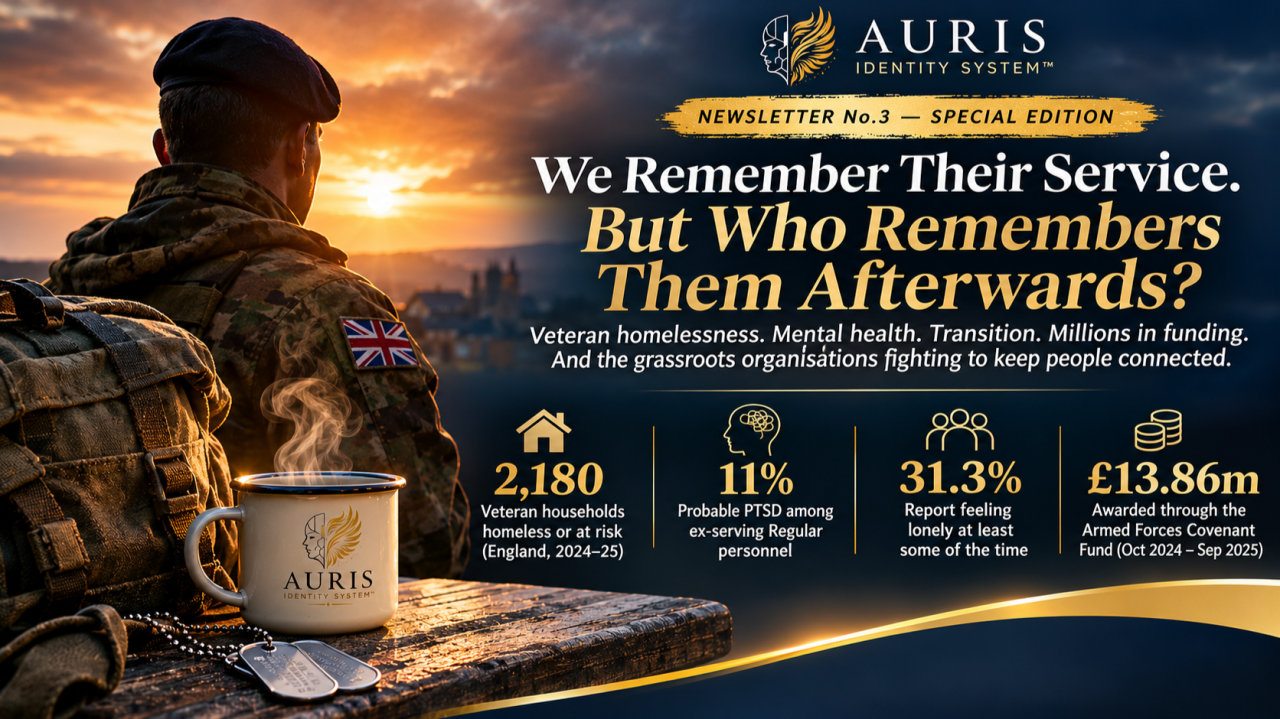
We Remember Their Service. But Who Remembers Them Afterwards?
A reflection on veteran housing, mental health, funding and community support, with sources, clear limits and questions about life after military service.
 Essay · 24 October 2026
Leaving the role. Finding where you belong.
Identity and belonging after leaving a role, with dated community consultation findings, practical reflection and two separate research invitations.
 Announcement · 11 October 2026
AURIS Is Evolving: Building What Comes Next
Gemma Gardner explains the next stage of AURIS, bringing research, learning, reflection and community connection together through a developing framework.