
We Remember Their Service. But Who Remembers Them Afterwards?
Identity After the Uniform | Edition 03
A reflection on veteran housing, mental health, funding and community support, with sources, clear limits and questions about life after military service.
Originally published on LinkedIn, 1 November 2026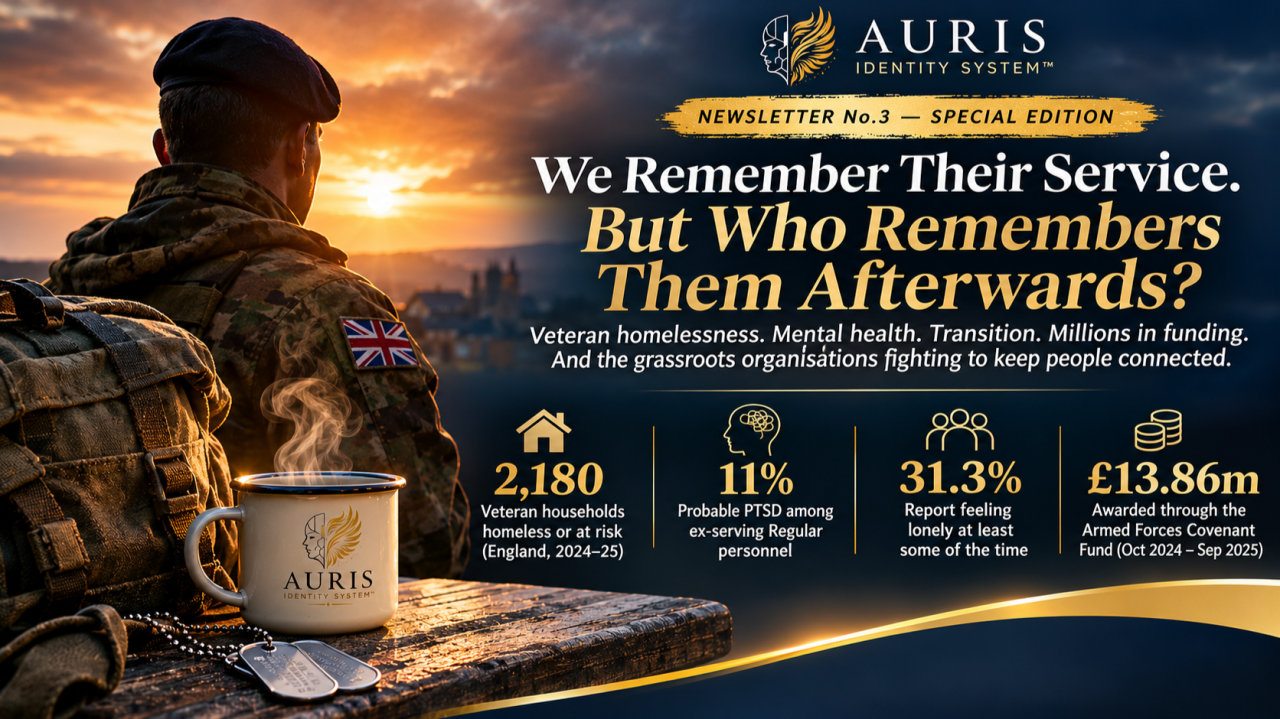
I won't lie. I'm angry.
Not at the people doing their best. Not at the charities changing lives. And certainly not at the veterans who have successfully built a new life after service.
I'm angry because we have so many conversations about supporting our Armed Forces community, yet I keep meeting people and organisations who are still fighting to be heard.
And the more research I do, the more one question keeps coming back to me.
Are we actually listening to what people need, or are we simply getting better at talking about support?
As we approach Remembrance, our social media feeds will fill with poppies, photographs, military stories and heartfelt tributes.
And rightly so.
But what happens on 12 November?
What happens when the ceremonies finish, the posts disappear and everyone returns to their normal lives?
Because for some veterans, the hardest part of military life begins when military life ends.
And for others, the difficulties don't emerge until years later.
The numbers we cannot ignore
In England, 2,180 veteran households were recorded as homeless or threatened with homelessness during 2024 to 2025. [R1]
That's not 2,180 people sleeping on the streets. It's the number of veteran households identified through statutory homelessness data. [R1]
And even the Government acknowledges those figures don't capture everyone.
Think about that.
We don't even have a complete picture of how many former service personnel are experiencing housing insecurity.
Then there's mental health.
King's College London's long running research into the health and wellbeing of serving personnel and veterans reported that: [R2]
28% of respondents experienced symptoms of common mental disorders. 9% had probable PTSD. Among former serving Regular personnel, probable PTSD was 11%, compared with 7% among serving Regulars. [R2]
These figures come from a particular military research cohort, not every veteran in the UK.
Most respondents in this study did not report probable PTSD. [R2]
But the people who do need appropriate support.
The weighted results of the Veterans’ Survey 2022 showed that 31.3% of respondents reported feeling lonely always, often or some of the time. [R3]
The survey has limitations, including an overrepresentation of disabled veterans, but its findings still deserve attention. [R3]
Because loneliness isn't always obvious.
You can have a job and feel lonely.
You can have a family and feel disconnected.
You can have a house, a car and what looks like a perfectly successful civilian life, yet still struggle to answer one simple question.
Who am I now?
We need to stop pretending transition has a finish line
I've seen people quote figures suggesting that 52% of veterans transition successfully and 48% struggle.
I haven't found sufficient evidence to support that as a national success or failure rate, and I won't use it as one.
What the Office for National Statistics actually found in its Veterans' Survey was that just 43.2% of respondents felt prepared or very prepared for civilian life, while 34.7% felt unprepared or very unprepared. [R4]
That doesn't mean everyone who felt unprepared went on to struggle.
But it should make us question what we mean by a successful transition.
Is it getting a job?
Finding somewhere to live?
Receiving a pension?
Or is it also about belonging, identity, purpose, confidence and the ability to build a life that feels like your own?
Because you can tick every administrative box and still feel completely lost.
And you can leave the military decades ago and only begin questioning your identity much later.
Discharge is a date. Transition is a human experience.
They are not the same thing.
Millions in funding. So where is the accountability?
Between October 2024 and September 2025, the Armed Forces Covenant Fund awarded approximately £13.86 million in grants. [R5]
The annual report estimated that funded projects would reach more than 301,000 beneficiaries. [R5]
That represents significant investment.
And I want to be absolutely clear: there are excellent national charities, dedicated professionals and effective government supported programmes making a genuine difference.
But awarding funding and estimating reach are not the same as proving long term outcomes.
I want to know what happens after the referral.
After the first appointment.
After the funded project finishes.
Did the person receive the support they needed?
Did their circumstances improve?
Were they still connected to support six months later?
Did someone follow up when they stopped attending?
We should be measuring changed lives, not simply counting activities.
And there's another question I believe deserves much more attention.
How much of the available funding reaches smaller grassroots organisations?
How many CICs apply and are unsuccessful?
How many have excellent relationships with their communities but lack the time, staff or resources to compete for grants?
I haven't found a reliable national comparison answering those questions.
That's precisely why I think we should be asking them.
Not because every large charity is failing.
Not because every small CIC is automatically effective.
But because funding decisions should be transparent, proportionate and grounded in evidence of need and delivery.
The people holding communities together
I want to talk about the grassroots organisations.
The little CICs.
The community groups.
The volunteers who work all day and then spend their evenings helping somebody else.
The people who open a building, put the kettle on and create somewhere a veteran feels comfortable walking through the door.
People who notice when someone hasn't turned up.
Who make the telephone call.
Who help complete a form.
Who sit and listen without watching the clock.
Through my work with Trafford Veterans CIC and my conversations with other grassroots organisations, I've seen how much commitment exists at community level.
These organisations aren't necessarily glamorous.
They don't always have marketing departments, professional bid writers or teams producing impact reports.
But they may have something equally important.
Trust.
And trust is not something you can simply buy with a grant.
I also want to be fair to funders.
The Armed Forces Covenant Fund Trust does support smaller organisations. Its published Hidden Voices awards for 2024 to 2025 included grants to organisations such as Battling On CIC. [R6]
That matters.
The question is whether enough small organisations can access the right funding, develop their capacity and sustain effective work.
Because there is something deeply uncomfortable about expecting people to provide reliable community support while relying indefinitely on exhausted volunteers.
Goodwill is powerful. But goodwill alone is not a sustainable funding model.
And now we're talking about recalling former personnel
On 27 October 2026, the Ministry of Defence confirmed plans to engage with former personnel who already have continuing recall liabilities. [R7]
It also outlined plans to invite around 1,000 Strategic Reservists to participate voluntarily in a NATO exercise in spring 2027. [R7]
That's not the same as announcing the compulsory recall of 1,000 veterans.
But it has prompted an important conversation.
We recognise the experience and skills former service personnel bring to national defence.
We recognise the value of maintaining connections with the military.
But are we giving the same attention to their civilian lives?
Their employment?
Their families?
Their health?
Their changing identities?
For some veterans, reconnecting with military service may be welcome.
For others, it may raise questions they thought they had already resolved.
And for some, the process of building a civilian identity may still be ongoing.
If we want to maintain a meaningful relationship with former personnel, we must be prepared to listen to them as people, not simply regard them as a reserve of military skills.
LinkedIn, I think we need to have a conversation
This is where I become frustrated with professional networking.
We have employers, researchers, funders, policymakers, charity leaders and veterans all sharing the same space.
We congratulate one another.
We celebrate appointments.
We share awards.
We like inspirational posts.
And then we scroll past somebody quietly asking for help.
I know that's not everyone.
I've met wonderful people through LinkedIn who have opened doors, shared knowledge and supported my work.
I'm grateful to them.
But imagine what could happen if more of us used this platform to do something practical.
Not just share a post about veteran homelessness.
Introduce a housing organisation to somebody who can help.
Not just congratulate a charity on receiving funding.
Ask whether a smaller organisation could benefit from its expertise.
Not just applaud a veteran's success story.
Offer an opportunity to somebody who hasn't found their feet yet.
A like is not a referral. A comment is not a partnership. And visibility is not the same as support.
We can do better than that.
And I include myself in that challenge.
Why this matters so personally
I owe you an apology for not maintaining the fortnightly newsletter schedule.
But I also want to explain why.
I'm building AURIS Institute and conducting Identity After the Uniform as an independent researcher.
There is no external research grant behind this project.
No investor funding the interviews.
No large organisation paying for the hours I spend investigating what people tell me.
I work part time as a marketing advisor for a wonderful family business in Barrow in Furness.
My evenings, weekends and days off are spent building AURIS, interviewing people, examining research and developing resources.
My husband gives his coaching time free of charge to local charities.
Our son has served too.
We're a family of former soldiers, and we believe deeply in the importance of this work.
But I won't pretend that makes everything easy.
There are bills to pay.
There are family responsibilities.
There are moments of exhaustion and uncertainty.
And there are times when I wonder how we're going to keep everything going.
I don't share that for sympathy. I share it because I refuse to pretend meaningful work happens without personal cost.
And I know there are people running small charities and CICs who understand exactly what I mean.
The reason I started Identity After the Uniform
My research isn't about proving that military transition is broken.
It's about understanding what actually happens to people.
The good experiences.
The difficult ones.
The unexpected changes.
The sense of freedom some people discover.
The loss of identity others describe.
The effect on relationships, families, purpose and belonging.
Through my Identity After the Uniform interviews, I give people space to tell their own stories.
Then I go away and research the issues they've raised.
I examine the evidence.
I look for patterns and differences.
And I question my own assumptions.
Because a moving personal story is not automatically evidence that everyone experiences the same thing.
But it can reveal something we have overlooked.
That's why the YouTube series matters to me.
These conversations deserve to be heard beyond the room in which they take place.
And I want more people to take part.
You don't have to have struggled.
You don't have to have achieved something extraordinary.
You don't have to have a dramatic story.
You can have left last month or thirty years ago.
You can be a veteran, a serving person preparing to leave or a family member whose life changed alongside somebody else's.
If you're willing to share your experience, I'd love to hear from you.
So what happens now?
I don't want this newsletter to become another post that receives a few comments before disappearing.
I want it to start something useful.
I want to hear from the grassroots CICs doing extraordinary work.
I want to understand the barriers they're facing.
I want funders and larger organisations to explain how they support community led delivery and what evidence they use to judge long term impact.
I want employers to consider how they could open doors for veterans.
I want researchers to share findings that can help us ask better questions.
And I want people who have experienced military transition to know their voices matter, whether their stories are positive, difficult or somewhere in between.
Because there is no single veteran experience. And there should never be a single assumption about what support someone needs.
To everyone who has already supported my work, trusted me with an interview, shared a connection or encouraged me when things have been difficult: thank you.
You remind me why I keep going.
But I want to end with a challenge.
As Remembrance approaches, we're going to see countless messages about honouring service and sacrifice.
Please share them.
Please remember.
But afterwards, ask yourself something.
What have I actually done to help somebody build a life after service?
Have I listened?
Have I made an introduction?
Have I offered an opportunity?
Have I supported a grassroots organisation?
Have I helped someone feel they belong?
Because we cannot build a better future for the Armed Forces community through applause alone.
We need honesty.
We need evidence.
We need accountability.
And above all, we need people who are prepared to work together.
We remember what people did in uniform.
It's time we paid just as much attention to the lives they're building afterwards.
I have three requests.
If you run or know a grassroots charity or CIC doing meaningful work, please name them in the original LinkedIn discussion. I want to learn about them.
If you can offer expertise, introductions, research or practical support, please say so. Someone reading this may need exactly what you can offer.
And if you'd like to share your experience through Identity After the Uniform, please get in touch. I'm always looking for more voices.
Let's make this more than another conversation.
Let's make some connections that actually lead somewhere.
Gemma Gardner
Founder, AURIS Institute
Independent Researcher | Identity After the Uniform
Sources and notes
R1. UK Parliament (2025). Veterans: Homelessness. Written question 100073, answered 18 December. Government written answer. 2,180 veteran households in England at risk of or experiencing homelessness in 2024/25; incomplete coverage. Not a rough sleeping count.
R2. Sharp, M.-L. et al. (2024). Health and Wellbeing Study of Serving and Ex-Serving UK Armed Forces Personnel: Phase 4. King’s College London, Office for Veterans’ Affairs final report, September. Commissioned longitudinal cohort report; not labelled a peer reviewed journal article. 28% symptoms of common mental disorders; 9% probable PTSD; 11% ex-serving Regulars versus 7% serving Regulars in this study. Symptoms and screening thresholds are not clinical diagnoses.
R3. Office for National Statistics (2024). Health and wellbeing of UK armed forces veterans: Veterans’ Survey 2022, UK. 4 December. Official survey analysis, self-selected respondents with weighting and coverage limitations. 31.3% reported feeling lonely always, often or some of the time. Disabled veterans overrepresented; no uncomplicated population comparison.
R4. Office for National Statistics (2024). Preparedness to leave the UK armed forces: Veterans’ Survey 2022, UK. 22 August. Official survey analysis. 43.2% prepared or very prepared; 34.7% unprepared or very unprepared. Retrospective perceptions, not success or failure rates.
R5. Ministry of Defence (2025). Armed Forces Covenant and Veterans Annual Report 2025. Covenant Fund in action, printed page 62. Government annual report. Covenant Fund awards £13,856,843 from 1 October 2024 to 30 September 2025; estimated 301,416 beneficiaries. This is a defined fund, not all Trust grant making, nor independently established unique-person outcomes.
R6. Armed Forces Covenant Fund Trust (2025). Hidden Voices programme: published awards, including Battling On CIC, Stepping Forward. Funder award list. Published 2025 award to Battling On CIC for Stepping Forward. An award does not establish effectiveness.
R7. UK Parliament (2026). Reserve Forces. Written question 36562, answered 27 October. Government written answer, plans as at that date. Engagement with continuing liabilities; planned invitation to up to around 1,000 Strategic Reservists, voluntary and short duration, spring 2027 exercise. Not compulsory recall announcement.
More from Insights and Updates
 Essay · 12 November 2026
The Silence Has Ended. But Their Stories Must Never Be Forgotten.
A Remembrance Sunday reflection on the fallen, bereaved families, veterans and serving personnel, and the care that continues after the ceremonies end.
 Essay · 24 October 2026
Leaving the role. Finding where you belong.
Identity and belonging after leaving a role, with dated community consultation findings, practical reflection and two separate research invitations.
 Announcement · 11 October 2026
AURIS Is Evolving: Building What Comes Next
Gemma Gardner explains the next stage of AURIS, bringing research, learning, reflection and community connection together through a developing framework.